Short Fiction, by Clark Ashton Smith
Jan. 18th, 2026 11:37 pm![[syndicated profile]](https://www.dreamwidth.org/img/silk/identity/feed.png) standardebooks_new_feed
standardebooks_new_feedA collection of short fiction by Clark Ashton Smith, ordered by date of publication.
standardebooks_new_feedslacktivist_feedhouse_chase_ao3_feedby slimypaws
House is no God. But Chase isn't either, so maybe they can work toward forgiveness together. No divine intervention needed.
Or
House leaves a little note and Chase follows it to House's apartment where a small surprise waits for him.
—
Part 3 of this Chouse Series. Could be read as a stand alone, but if you like context, check out the other parts first.
Words: 6969, Chapters: 1/1, Language: English
Series: Part 3 of O Father, my Father
![[personal profile]](https://www.dreamwidth.org/img/silk/identity/user.png) cimorenethistleingreystandardebooks_new_feedbaseball_rpf_ao3_feed
cimorenethistleingreystandardebooks_new_feedbaseball_rpf_ao3_feedby crochetstars
“Did she ever get you this hard?” Caleb asked, looking up at Pete.
His barely visible eyebrows furrowed, “Who?”
“Hailey,” Caleb clarified, “Were you ever like this for her?”
The question had Pete thinking for a moment, remembering all of their moments together. It was fun, it was good, even, but it was nothing memorable. Nothing like the past few times he had been with Caleb. He didn't think anything could compare to that.
He shook his head, “Only you can do this to me.”
--
Aka Caleb is a little jealous after a talk about exes
Words: 2325, Chapters: 1/1, Language: English
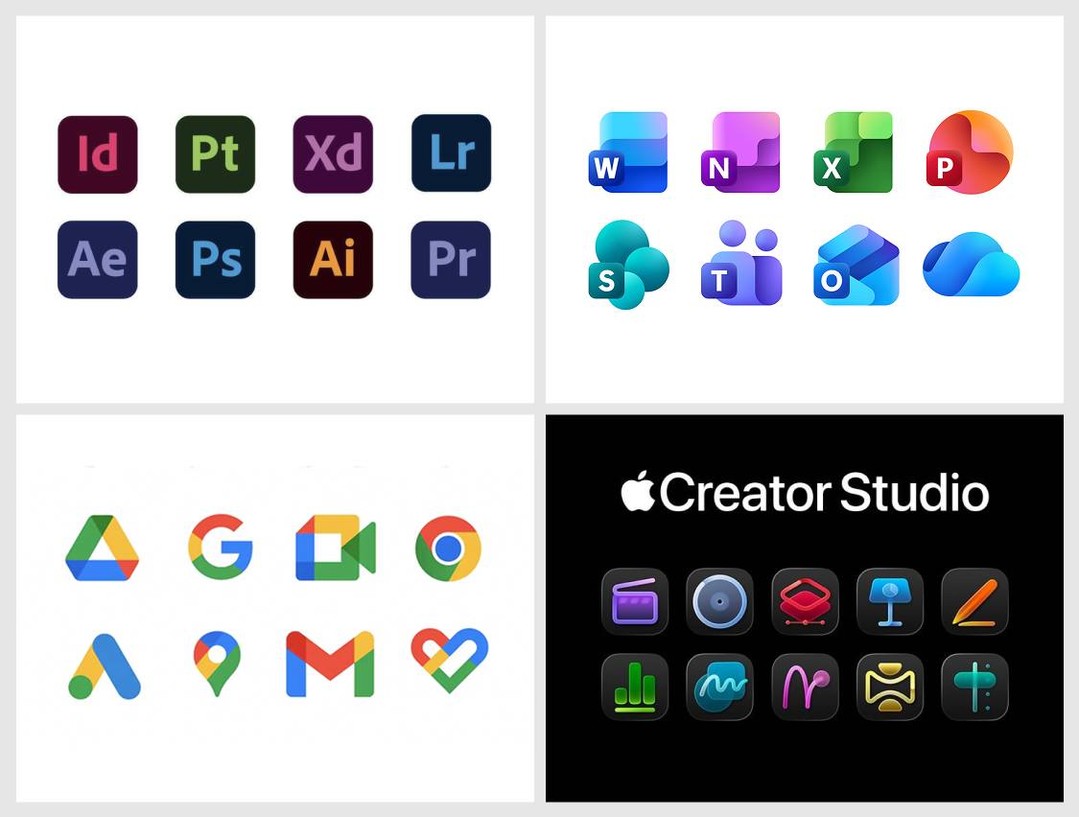
daringfireballfeed_feedThere’s a lot of hate for the new app icons of the entire Creator Studio suite, but while I think the icons are tragically simplistic, I think the hate is misplaced.
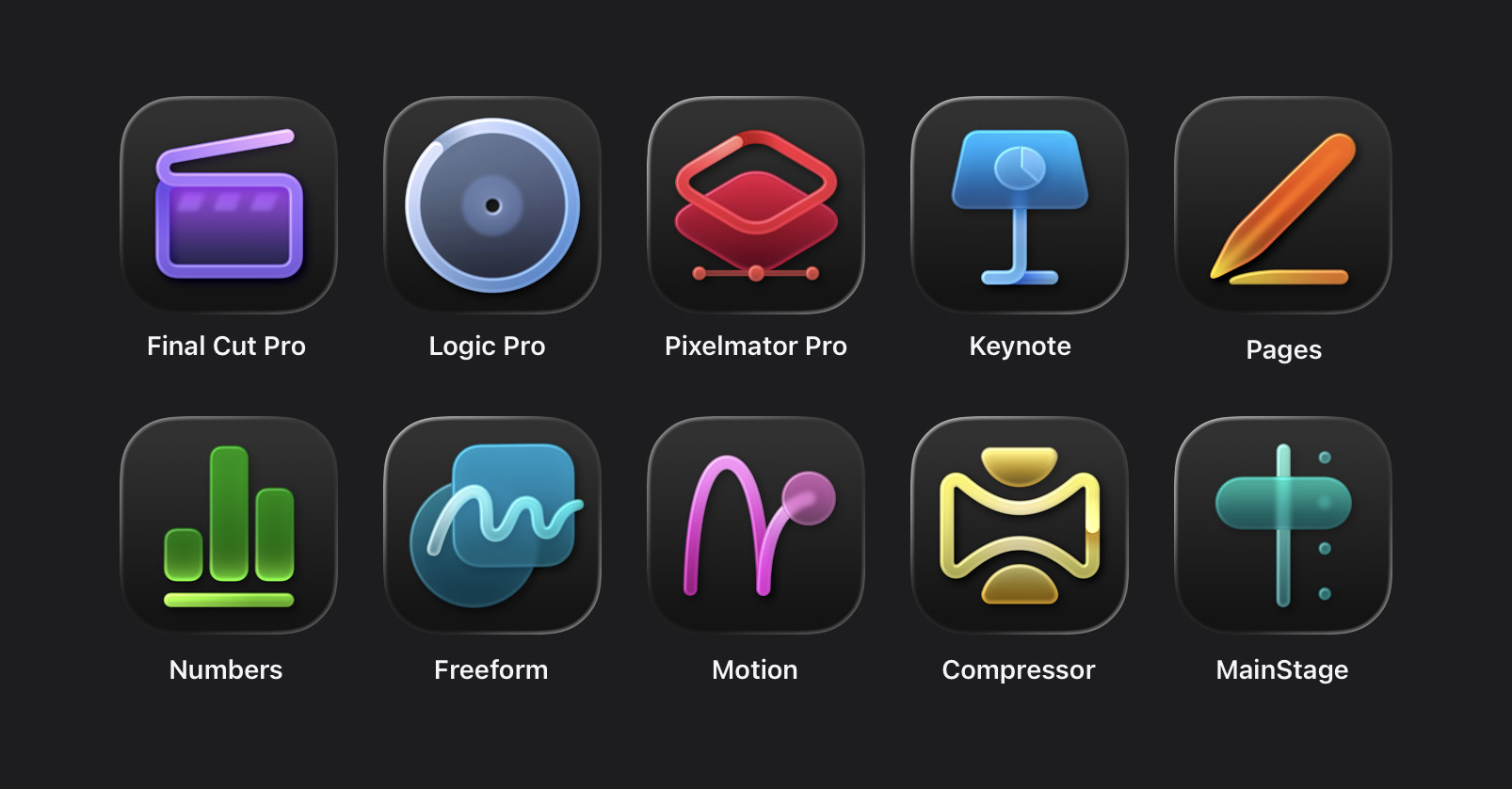
The problem isn’t with these icons in and of themselves. The problem is with the rules Apple has imposed for Liquid Glass app icons, along with their own style guidelines for how to comply with those rules. Given Apple’s own self-imposed constraints for how icons must look (with the mandatory squircle) and how Apple has decided its own app icons should look (a look which can best be described as crude), I actually think the icons in the Creator Studio are pretty good, relatively speaking. But that’s like saying one group of kids has pretty good haircuts, relatively speaking, at a summer camp where the rule is that the kids all cut each others’ hair using only fingernail clippers.
The best take on these icons is this zinger from Héliographe:
If you put the Apple icons in reverse it looks like the portfolio of someone getting really really good at icon design.
Devastating. Whatever you think of this new 2026 icon for Pages, you can’t seriously argue that it’s much worse — or really all that different — from the previous one. But go back in time and each previous Pages icon had more detail and looked cooler. And then you get back to the original Pages icon and that one clearly belongs in the App Icon Hall of Fame.
At some point in the previous decade, I had a product briefing with Jony Ive where we were discussing some just-announced new device that largely looked like the previous generation of the same device. I honestly don’t remember if it was an iPhone, an Apple Watch, or a MacBook. It doesn’t matter. What Ive told me is that Apple didn’t change things just for the sake of changing them. That Apple was insistent on only changing things if the change made things better. And that this was difficult, at times, because the urge to do something that looks new and different is strong, especially in tech. “New” shows that you’re doing something. “The same” is boring. What’s difficult is embracing the fact that boring can be good, especially if the alternative is different-but-worse, or even just different-but-not-better. You need confidence to ship something new that looks like the old version, because you know it’s still the best design. You need confidence to trust yourself to know the difference between familiarity (which is comforting) and complacency (which is how winners become losers).
Apple’s hardware designs remain incredibly confident. An M5 MacBook Pro looks like an M1 MacBook Pro, and really hasn’t changed much in the last decade other than getting thinner. An iPhone 17 Pro looks a lot like an iPhone 12 Pro and has only evolved in small ways since the iPhone X in 2017. A brand-new Series 11 Apple Watch is very hard to distinguish at a glance from a Series 0 Apple Watch from 2015. This is not a complaint, this is a compliment. These hardware designs do not need to change because they’re excellent. Iconic, dare I say.
This is why Apple’s software UI designs are the target of so much scorn and criticism right now, and Apple’s hardware designs are not.1 Yes, it’s human nature that people love to complain. But Apple’s current work isn’t receiving criticism in anything close to equal measures. Apple’s hardware is hardly the subject of any criticism at all. Not the way it looks, not the way it performs. Apple’s software design, on the other hand, is the subject of withering criticism. It’s not (just) about new features having bad designs. It’s about existing, decades-old features being made so obviously worse. I know a lot of talented UI designers and a lot of insightful UI critics. All of them agree that MacOS’s UI has gotten drastically worse over the last 10 years, in ways that seem so obviously worse that it boggles the mind how it happened.
Take a few minutes and go peruse Stephen Hackett’s extensive MacOS Screenshot Library at 512 Pixels, where he’s assembled copious screenshots from every version of MacOS going back to the Mac OS X Public Beta from October 2000.2 Take a look in particular at MacOS 10.11 El Capitan from 2015, exactly a decade ago. It doesn’t look old compared to MacOS 26 Tahoe. It just looks better, in every single way. I can’t think of one single thing about MacOS 26 that looks better than MacOS 10.11 from 2015, and I can quickly name dozens of things that are obviously worse. We would rejoice if MacOS 27 simply reverted to the UI of MacOS 10.11 from a decade ago, or had evolved as subtly as Mac hardware has over the same decade. The menu bar was better. The contrast between active and inactive windows was better. The standard UI controls looked better. The delineation between application chrome and content was clear, rather than deliberately obfuscated. And, to return to my point regarding Apple Creator Studio, all of the app icons — every goddamn one of them — was better. Many of the Mac app icons from MacOS 10.11 were downright exquisite. And the real heyday for Apple’s application icon design was the decade prior, the 2000s, under Steve Jobs. At the time, in 2015, we thought El Capitan shipped during an era of somewhat lazy icon design from Apple. If only we knew then how good we still had it.
Before you ask, there’s no point wondering why these new Creator Suite icons look like this if Alan Dye and his inner squircle of magazine-designer cowboys left to work at Meta a month ago. I genuinely believe that Dye’s departure and the promotion of longtime Apple UI designer Steve Lemay to replace him will restore some measure of sanity and grace to Apple’s UI direction and style. That can’t happen in one month (let alone a month taken up by major holidays). For now, Creator Studio needs to abide by the guidelines of the OS 26 Liquid Glass world.
Two more zingers. Benjamin Mayo on the new Pixelmator icon (the first new icon since Apple’s acquisition):
the ultimate icon downgrade
The new Pixelmator icon is the most jarring of the bunch because it hasn’t been on the drip-drip-drip yearslong slide of Apple’s in-house app icons. It just switched in one fell swoop from something that looks like art that one might print, frame, and hang on their wall, to, well, whatever the new one is.
The Boringification of Software
I could go on for thousands of words here, too. But let’s cut to the chase for a moment and acknowledge that “Liquid Glass”, as a catch-all term to describe the entirety of the UI changes in Apple’s version 26 OS releases, means a few different things. The most obvious thing it means is the lowercase liquid glass look. Transparency and fluidity. Let’s put that aside.
Liquid Glass also represents — per Apple’s own description when it was introduced by Alan Dye at WWDC — a “content-first” change to layout within an application. The content, in Liquid Glass, should take up as much of the screen, or window, as possible, and the UI of the application should be presented atop the content, not apart from the content. I’ll let Apple speak for itself and present Apple’s own video of the iOS Music app, from the Newsroom article announcing Liquid Glass back at WWDC:
This design ethos may or may not work on iOS. I think it often does. But let’s put that argument aside too. In the desktop context of MacOS, I don’t think this ethos works at all for most apps. It’s a downright disaster in the context of complex productivity apps. Apps should have distinctive chrome. The idea that they shouldn’t, that only “content” matters, and that apps themselves should try to be invisible and indistinctive, is contrary to the idea that apps themselves can be — should be — artistic works. The parts of a window that belong to the app and present the functionality of the app, and the parts of a window that represent content, should be distinct. Like separating the dashboard — sorry, instrument panel — from what you see through the windshield while driving a car. One or two items of primary importance (say, the speedometer and the next step in turn-by-turn directions) are OK to project on the windshield in a heads-up display atop the “content” of the road and world around the vehicle. But it would be disastrous to eliminate the instrument panel and project every control status indicator as HUD elements on the windshield. Either the driver’s view would be overwhelmed by too many HUD elements, making it hard to see the world and to read the dials, or the car designer would have to eliminate many useful controls and indicators entirely. (I know, some electric car makers are doing just that. It sucks.)
If you look through the screenshots Apple has provided of the new versions of the apps in the Creator Studio bundle, most of them haven’t been updated with Liquid Glass at all. They don’t have UI elements that look like liquid glass (transparent and fluid), and they don’t have layouts that seek to remove or obfuscate the application from its content. Final Cut Pro, Logic Pro, Motion: nope. Not a drop of Liquid Glass.
Pixelmator Pro does, however. It seems to embrace Liquid Glass in both senses. I haven’t tried it yet, and it doesn’t ship until January 28, but I strongly suspect I’d prefer if the new Pixelmator Pro looked like the new Final Cut Pro and Logic Pro, with solid, distinct user interface chrome. (Fingers crossed that there’s a setting for this.)
One possible explanation for Pixelmator Pro embracing Liquid Glass, but the other apps not, comes from the fineprint on the Apple Newsroom post announcing the whole Creator Studio suite:
Pixelmator Pro for iPad is compatible with iPad models with the A16, A17 Pro, or M1 chip or later running iPadOS 26 or later. The Apple Creator Studio version of Pixelmator Pro requires macOS 26.
The other apps require only MacOS 15.6 Sequoia and iOS 18.6:
The one-time-purchase versions of Final Cut Pro requires macOS 15.6 or later, Logic Pro requires macOS 15.6 or later, and Pixelmator Pro requires macOS 12.0 or later. MainStage is available for any Mac supported by macOS 15.6 or later. Motion requires macOS 15.6 or later. Compressor requires macOS 15.6 or later and some features require a Mac with Apple silicon.
MacOS 12 Monterey came out in 2021. So I think that means you can one-time purchase and download an older version of Pixelmator, if you’re running an older version of MacOS. But if you’re running MacOS 26 Tahoe, you’ll get the new Liquid-Glassified version of Pixelmator whether you get it as a one-time purchase or through a Creator Studio subscription. I think? Update: That was wrong. It’s a little simpler than that, in that Pixelmator Pro is an outlier from the other apps in Creator Studio. The new version of Pixelmator Pro — version 4.0 — is only available through the Creator Studio subscription, and requires MacOS 26 (and iPadOS 26). The one-time purchase version of Pixelmator Pro is version 3.7.1 — the existing version, last updated two months ago — and that’s the version you get from MacOS 12 through MacOS 26 if you get it via one-time purchase. Pixelmator Pro is the only app in Creator Studio where the new version is exclusively available through the Creator Studio subscription.
From the Newsroom announcement:
For more than 20 years, Apple’s visual productivity apps have empowered users to express themselves with beautiful presentations, documents, and spreadsheets using Keynote, Pages, and Numbers. And Freeform has brought endless possibilities for creative brainstorming and visual collaboration.
I’m not sure when Apple stopped referring to these apps, collectively, as iWork, but I guess it’s probably when they stopped selling them and made them free for all users in 2017. (Freeform was launched in 2022, so was never part of “iWork”. But it does feel like a fourth app in the suite.)
With Apple Creator Studio, productivity gets supercharged with all-new features that bring more intelligence and premium content to creators’ fingertips so they can take their projects to the next level. The Content Hub is a new space where users can find curated, high-quality photos, graphics, and illustrations. A subscription also unlocks new premium templates and themes in Keynote, Pages, and Numbers.
In addition to Image Playground, advanced image creation and editing tools let users create high-quality images from text, or transform existing images, using generative models from OpenAI. On-device AI models enable Super Resolution to upscale images while keeping them sharp and detailed, and Auto Crop provides intelligent crop suggestions, helping users find eye-catching compositions for photos.
To help users prepare presentations even more quickly in Keynote, Apple Creator Studio includes access to features in beta, such as the ability to generate a first draft of a presentation from a text outline, or create presenter notes from existing slides. Subscribers can also quickly clean up slides to fix layout and object placement. And in Numbers, subscribers can generate formulas and fill in tables based on pattern recognition with Magic Fill.
I’ll co-sign Jason Snell’s column on this aspect of Creator Studio. I feel like it’s just fine for new document templates and the Content Hub stock image library to be paid features. (See next section.) But I don’t think it makes sense to gate useful new features of these apps behind the Creator Studio subscription. Smarter autofill in Numbers, generating Keynote slides from a text outline, and Super Resolution image upscaling all sound like great features, but they sound like the sort of features all users should be getting in the iWork apps in 2026. Especially from on-device AI models. I could countenance an argument that AI-powered features that are processed on Apple’s Private Cloud Compute servers should require a subscription. But it feels like a rip-off if they’re running on-device.
It’s simpler for Apple to offer one single subscription bundle of “work” apps. But office productivity apps and creative design apps are very different. A word processor and spreadsheet go together. A video editor and audio editor go together. But it seems wrong for someone who just wants the new AI-powered features in Numbers and Keynote to need to pay for a subscription bundle whose value is primarily derived from Final Cut Pro, Logic Pro, Motion, and Pixelmator Pro — apps that many iWork users might never launch.
Apple describes the Content Hub as “a new space where users can find curated, high-quality photos, graphics, and illustrations.” Stock imagery, basically. From Apple’s Creator Studio FAQ:
What happens to projects and content I created if my subscription ends?
All the projects and content you create with an active subscription to Apple Creator Studio — including any images you generate or add from the Content Hub — remain licensed in the context of your original creation.
What struck me about the Content Hub is its name. Despite only offering “photos, graphics, and illustrations” it is not called the Image Hub. It’s the Content Hub. I asked Apple if this meant it might eventually include other things, like music, video B-roll, and perhaps even fonts licensed from third-party type libraries. I was told — unsurprisingly3 — that they can’t comment on future products and features. But that was said with a smile, which smile at least acknowledged that the name Content Hub leaves the door open to other types of media.
When Apple acquired Pixelmator a little over a year ago, they acquired two ambitious creative professional apps, not one. Pixelmator is an image editor, like Adobe Photoshop (or, from the indie world, Acorn). Photomator is like Adobe Lightroom (or, from the indie world, Darkroom.) We’ve been waiting to see what Apple’s plans were for both apps. With Pixelmator Pro, we now have an answer — a major new update for the Mac (with, as mentioned above, a Liquid Glass UI) and an all-new version now available for iPad.
This week’s announcement of the Creator Studio bundle included no news about the future of Photomator. However, my spidey-sense says this is a case where no news might be good news. At the bottom of Apple’s new product page for Pixelmator Pro is a brief Q&A, which includes these two items:
Where can I get Photomator?
Photomator remains available as a separate purchase from the App Store.
How does Pixelmator Pro compare to Pixelmator Classic for iPad?
Pixelmator Pro for iPad is available as part of an Apple Creator Studio subscription, alongside the Mac version and other pro apps like Final Cut Pro and Logic Pro. It brings all the features that Pixelmator Pro users love on Mac to iPad, including nondestructive editing, AI features, tools for freely transforming layers, and more — all optimized for touch.
Pixelmator Classic for iOS, released in 2014 as a companion app to the now-discontinued Pixelmator Classic for Mac, provides basic image editing features such as cropping, color adjustments, and effects. It remains a functional app but is no longer being updated.
These are very different answers, if you speak Cupertino-ese. Functional but no longer being updated means you should not hold your breath waiting for an updated version of Pixelmator that runs on an iPhone.
When Apple end-of-lifes an app — like they recently did with Clips — they’re clear about it. But when Apple has plans for something but isn’t ready to announce those plans, they’re obtuse about it. If Photomator did not have a future as part of Creator Studio, I think Apple would have used this moment to stop selling the existing version. They’d say that it too remains functional but is no longer being updated. But that’s not what they said.
Apple’s Aperture — a photo library manager and editor for professionals — debuted in October 2005. Adobe released the first public beta of what became Lightroom in January 2006. Lightroom today remains an actively-developed popular app. But Apple ceased development of Aperture in 2014. Times change. In 2014 Apple clearly did not anticipate that a decade later they’d want to take on Adobe’s Creative Suite. Here in 2026, Apple has just launched the first version of that rival to Adobe’s suite. Perhaps the biggest omission4 in this first release of Apple Creator Studio is the lack of a Lightroom rival, which is exactly what Photomator is — and Aperture was. My guess is that Apple and the acquired Pixelmator team are hard at work on a new Creator Studio version of Photomator, including a version for iPad, and it just isn’t finished yet. I’m more unsure whether they’ll keep the Photomator name (which I think is too easily conflated with the Pixelmator name) than whether they’re working on an ambitious update to the app to include in Creator Studio.
I have no little birdie insider information about that, just my own hunch. I just think that if Photomator didn’t have a future, Apple’s statement about it would say so, and they’d stop selling the current version. And the lack of a professional photo library app is a glaring omission in Creator Studio. Apple Photos is an outstanding app, and iCloud Photo Library has in my experience delivered fast dependable syncing across devices for several years now. But an app like Photos, that is necessarily anchored to the needs of very casual users, can’t possibly scale in complexity to meet the needs of professional photographers. And Photos is not fully satisfying for prosumer users like me.
The standard subscription for Creator Studio costs $13/month or $130/year, and subscriptions are eligible for sharing with up to five other people in a family sharing group. Apple is also offering Creator Studio education pricing for students and educators for $3/month or $30/year. That’s a nice discount. But, I confirmed with Apple, the education subscription is not eligible for family sharing.
I think Apple’s pricing for Creator Studio is very fair. It’s a decent value for $130/year, a great value with the education discount, and it’s nice that Apple is still offering one-time purchasing, per app, for those who object to software subscriptions (or those who simply know they only want to use one or two of these apps). But the fact that Creator Studio is only available as a separate subscription puts the lie to the “One” in the Apple One subscription bundle. Apple One is a good value, and Creator Studio is a good value, but Apple One is no longer one bundle that includes all of Apple’s subscription offerings. It’s more like Apple Most now.
This is also, I think, why John Ternus is so heavily rumored to be named Tim Cook’s successor as CEO, and everyone feels cautiously optimistic about that. In the entire 50-year history of the company, Apple has never been on a longer sustained streak of excellent hardware than they are today. No one feels the same way about Apple’s software, services, or marketing. ↩︎
If Hackett weren’t so lazy, he’d document the classic Mac system software era too. ↩︎︎
Now that I think about it, if Apple’s representative had answered my question by saying something like, “Yes, we’re definitely thinking about other types of media that we could add to the Content Hub in the future, and that’s why we gave it that name,” I would have plotzed. ↩︎︎
Another is that Adobe Creative Cloud includes access to Adobe’s entire library of fonts, the biggest type library in the world. But like I wrote above, Apple Creator Studio’s “Content Hub” is an open-ended name. I’d love to see Apple work out licensing deals with a broad assortment of typography houses. ↩︎︎
ao3_news_feed
Last November we asked the community to submit questions to our OTW volunteers in celebration of International Volunteer Day. In this series of posts we will spotlight some of our committees' responses.
The Tag Wrangling committee sorts, organizes, and connects tags used on the Archive of Our Own (AO3) website, according to Tag Wrangling guidelines, to make them more easily filterable by users. They work, for example, closely with the Support committee to handle user requests for sorting and connecting tags, and the Open Doors committee to "map" tags used in other archives.
We asked the Tag Wrangling committee for replies to your questions, and received a lot of feedback! Below you can find a selection of their answers:
Question: First, thank you for all the work you've been doing on the No Fandom Freeforms this year. I and many people I know are very happy about the newly canonized tags. I have been following developments on another Wrangling Policy, fandom metatags, with interest for several years, and I was excited to see an update about it in the June 2025 Newsletter (https://archiveofourown.org/admin_posts/31888). Is there anything more you can tell us about that process, like what 'phase two of three' means or what sort of timeframe we can expect to see changes to the publicly accessible Wrangling Guidelines or fandom tags?
Committee answer:
Thank you for the kind words! For major changes to the Guidelines, we have a three phase process that we work through.
In terms of a timeframe, it's very dependent on how complex the initial issue is and how quickly we are able to find a solution that addresses most major concerns. While we understand that a long wait can be frustrating, making sure we take adequate time to fully understand and address all aspects of an issue should minimize negative unintended consequences and prevent the need to revisit guidelines too frequently.
Question: A couple times now, I have advised other AO3 users dealing with fandom tags that haven't been canonized, sometimes for months. I've told them to use the Support Form to raise the issue and hopefully get a wrangler designated to manage the fandom. Do you have specific advice for what to information put on the support form that would help Support and Tag Wrangling process the request?
Committee answer:
Thank you for directing users with questions or concerns to Support! That is exactly the right strategy for these situations. If a fandom tag has had a work visible on it (i.e. not in an unrevealed collection) for more than a month, you are welcome to fill in the Support form to request its canonization, using their contact form.
It’s fine to include multiple tags in the same request that you would like to have reviewed.
When you submit a Support request, it can be helpful to provide links to information on the the sources of canon as this will aid the fandom bin wranglers in identifying and actioning the fandom tag, especially if it’s difficult to search for or could easily be confused with another fandom (say, a movie with the same name released in another country).
Links to sources provided can include information databases, official websites, and places where the canon source can be purchased. They do not need to be in English, particularly if the source material is non-English (where we may need to refer to non-English sources as part of actioning the tag!) though including non-English sources may increase the number of volunteers who need to review your request.
Question: What's the process for moving an unofficial/freeform tag into a proper one you can filter with?
Committee answer:
Great question! Here is a very brief description of the life cycle of a tag.
A user adds a tag on their work. A wrangler then reviews tags in the "bins" assigned to them and determines whether the tag is fandom-specific (Example: The Force from Star Wars) or a general concept (Example: planets). If the former, the tag is "wrangled" to the particular fandom. If the latter, the tag is assigned to "No Fandom".
What happens from this point is dependent on the type of tag (Character, Relationship, or Additional). There are specific criteria for whether a tag should be made a "canonical" or a "synonym". (You can find definitions for all of these wrangling-related terms in our Tag Wrangling Guidelines). Some tags require a minimum level of usage before they will be canonized/appear in the autocomplete/filters.
General concept tags stored in No Fandom typically need to go through a special process of review and discussion by the Tag Wrangling committee before they can be canonized. This process is in place to ensure tags are organized, easily understood by users, and do not duplicate existing canonicals.
How many hours a week do you spend on your OTW volunteer work?
This answer varies a lot in Tag Wrangling depending on what projects people are working on and their chosen self-assigned workloads. In general, many wranglers prefer not to track the specific time spent, with some of the joking answers shared including: “I reserve the right to to be silent”, “more than I probably should” and “that's between me and the hyperfixation gods”.
The reality is like Cascade says: “It varies! Sometimes just an hour or two to clean up small fandoms, other times I get into the zone and will spend 10 or more hours in busier fandoms or working on a large project.”
How do you manage your volunteer time, and do you do the same thing every day like with a day job?
What's your favorite part about volunteering at the OTW?
What's the aspect of volunteer work with the OTW that you most wish more people knew about?
What does a typical day as an OTW volunteer looks like for you?
What is your favorite animal? Alternatively, do you have a favorite breed of cat/dog?
Do you enjoy reading fanfic? If so, what's your favorite work on AO3?
Do you write any fanfic yourself? What do you enjoy about it?
What fandoms are you (currently) in?
Wranglers are in many fandoms that are constantly changing, but a few of the current ones that were volunteered include but are not limited to:
Ooe (Visual Novel), Digimon Adventure, Kingdom Hearts, Kanto Pokemon, Yu-Gi-Oh! GX, Helluva Boss, Malevolent (an Eldritch Horror podcast), Jurassic Park/World, Spider-Man, The Pitt, Batman, Heated Rivalry, Critical Role, Scum Villain and Aurora (Webcomic) in fact - many webcomics both large and small have wrangling fans currently in them!
Do you feel glad or proud to see fanfiction in your mother tongue?
Thanks so much to every volunteer who took the time to answer!
(For more answers from Tag Wranglers, check out this work on AO3, where we collect additional replies to each question!)
The Organization for Transformative Works is the non-profit parent organization of multiple projects including Archive of Our Own, Fanlore, Open Doors, OTW Legal Advocacy, and Transformative Works and Cultures. We are a fan-run, donor-supported organization staffed by volunteers. Find out more about us on our website.
little_women_ao3_feedby peasina
"It must be the brook
Can trust itself to go by contraries
The way I can with you -- and you with me --
Because we're -- we're -- I don't know what we are.
What are we?'"
Words: 18, Chapters: 1/1, Language: English
jjhunteracoup_feedThis is, at long last, the last part of our four-part series (I, II, IIIa, IIIb, Intermission, IVa). last time we looked at the social status of hoplites and the implications that had for the political and social structure of the polis and even the very basic question of how many people there were in ancient Greece.
I had originally planned for this week’s topic – the amount of training and combat experience hoplites had – to be an addendum to that discussion as it related to how we understand who hoplites are (yeoman soldiers or leisured elites? warrior elites or amateurs?) but there wasn’t the time to work it in. So it sits here almost as a coda to the entire series.
So that is what we are going to look at today: how were hoplites prepared for battle? This topic is going to be a bit more complicated than most of our neat binary orthodox-heterodox divides because they are divisions within the orthodox school here, although oddly those divisions don’t seem to me to be readily acknowledged. In particular, we might identify an old-orthodox position (hoplites drilled and trained), a new-orthodox VDH-position (hoplites fought a lot, but trained little), a non-scholarly and remarkably a-historical pop-orthodox Pressfield-position (hoplites did US Marines boot camp) and finally the heterodox position (hoplites were largely untrained amateurs).
So to tackle this question, we want to ask how often hoplites fought, what kind of training was available to them, when it was available and the degree to which it was compulsory. As we’re going to see, I think the evidence here leans in the heterodox position, though I would argue it doesn’t lean quite as far as Roel Konijnendijk, the heterodox scholar who I think has focused on this issue the most, might have it.
As always, if you like what you are reading, please share it as I rely on word-of-mouth to find readers! And if you really like it, you can support this project over at Patreon; I don’t promise not to use the money to buy a full hoplite panoply, but I also don’t not promise to do that. And if you want updates whenever a new post appears, you can click below for email updates or follow me on Twitter and Bluesky for updates when posts go live and my general musings; I have largely shifted over to Bluesky (I maintain some de minimis presence on Twitter), given that it has become a much better place for historical discussion than Twitter.

But we should start by trying to get a handle on what everyone’s positions actually are and here I think we do need to be careful to make a distinction between three kinds of ‘training’ involved in warfare. When we say drill, we mean training in groups, focused on practicing moving and fighting as a formation. By contrast, when we say training at arms (or ‘training in arms’) we mean individual combat training on how to use weapons. A good way to think about this is the contrast between how a marching band collectively trains to move together during their shows (drill) and how the individual musicians train independently to play their instruments well (training at arms, except the arms are trombones). Finally there is fitness training, which is focused neither on the specific motions of collective action (that’s drill) or the specific motions of individual fighting (that’s training at arms) but rather on strength, stamina and agility.
You will want to keep those terms separate because of course it is perfectly possible for armies to do one kind of training and not the others. Many types of ‘warriors’ for instance, might train for individual combat (training at arms) and even for personal fitness, but because they do not expect to fight in formation in large groups, they have little use for drill. On the other hand, in some societies where the expectation is that soldiers are recruited broadly from a farming class that is already very physically active, there might be less emphasis on fitness training, but if they expect them to fight in formation, a lot of emphasis on drill. And of course different weapons demand different degrees of training at arms: spears are generally easier to use with less training than swords or muskets and so on.
So we’re interested here in both how much training but also what kind of training and we cannot assume just because we see one kind of training that the others are present.
So with our terms in place, to outline the debate briefly, the early German scholars of our ‘Prussian Foundations,’ when they thought about hoplites largely assumed drill, because it was the ubiquitous understood principle of their day that drill was the way that soldiers could be made to fight in formation together.6 Consequently early hoplite orthodoxy assumed that hoplite formations must have drilled in order to function. Likewise, extrapolating from their own (gunpowder) warfare, they assumed rigid formations with standard spacing, assigned places in line which maneuvered like early modern musket or pike formations, marching in time and with standard evolutions to move from column into line and such.7 It seems to have legitimately not occured to these early scholars that there was any way to do close-order infantry that didn’t involve drill and so even though – as we’re going to see – there’s very little evidence to suggest that hoplites regularly drilled, they just assumed they did. So that is the ‘old’ orthodox position: it assumes hoplites drilled and practiced at arms, without a lot of evidence to support the notion, because that’s simply what – to them – soldiers did.
(This is also, I think, another example of ‘Rome acting as the frog DNA for studying Greece.’ The Romans did drill and practice at arms and we know that because the sources tell us repeatedly. But part of the reason the sources tell us is that the Roman practice was strange to them, which of course in turn suggests you cannot use it to fill in the gaps for Greece or anywhere else!)
That said, the ‘Restatement of the Orthodoxy’ phase – inaugurated by VDH’s The Western Way of War (1989) took an odd turn from this point an in some ways. While WWoW is, for the most part, simply a full-throated restatement of the old orthodoxy on hoplites, one of VDH’s obsessions was the idea (substantially critiqued in last week’s post) of the hoplites as ‘yeoman’ citizen-warriors, which leads him to stress the importance of civilian social bonds (sub-units of the polis, called tribes (φυλαί, ‘phulai’)) and thus not to assume the sort of drill that the older Prussian scholars (on whom he otherwise often relies) do. I haven’t found any specific point where VDH openly disputes the notion that hoplites had drill or training at arms, but he pretty clearly assumes they don’t.8
On the other hand, WWoW assumes that in the ideal, archaic form of hoplite warfare, hoplite battles were really frequent, assuming “battle of some type on an average of two out of every three years.”9 So VDH seems to assume that hoplites are untrained but that hoplite army fight so frequently that most hoplites would have a lot of experience, which would make up for being untrained. VDH’s assumptions about the frequency of hoplite battles are, uh, quite flawed, as we’re going to see.
At around the same time (the late 1990s), hoplites, particularly Spartans surged back into the popular consciousness through the action of Frank Miller’s comic 300 (1998) – it gets a film of the same name in (2006) and Steven Pressfield’s historical fiction novel Gates of Fire (1998). These form the bedrock of the modern popular misunderstanding of Sparta and are all terrible guides to the ancient world (despite Gates of Fire, to my eternal annoyance, frequently making military academy reading lists). Both pieces of popular culture are at best only tenuously connected to any actual historical scholarship or the actual historical sources and both, for reasons of their fiction, want to understand the Spartan agoge as super-badass warrior training. Both imagine both drill and training at arms in the context of Spartan training, with Pressfield especially imagining the agoge as an almost direct analogy to modern military training (particularly his own US Marine Corps boot camp). This is essentially a modern version of the same error our 19th century Prussians were making: assuming that armies have always worked the way they work now.
But this notion of hoplites generally and Spartans particularly as highly trained ‘super elite’ warriors persists in popular culture and leads to the sort of shocked incredulity one gets when noting that there is in fact relatively little evidence for extensive drill or any training at arms at Sparta, much less anywhere else.
Finally, there is the heterodox position, which has been most recently compiled and defended by Roel Konijnendijk in Classical Greek Tactics (2018), 39-71. Konijnendijk describes the question of training as a “hidden controversy” and I think that is right: there is in fact a lot of disagreement here, but because it is embedded in the assumptions beneath the arguments rather than the arguments themselves, it is rarely expressed as disagreement. Konijnendijk surveys the evidence and concludes, to quote him, “the typical Greek citizen hoplite knew no weapons drill, no formation drill, and understood only the simplest of signals“10 Konijnendijk allows for “modest advances” by smaller, more elite units in the late Classical but largely rejects a developmental model where the amount of training and drill increased over time.11 In short, hoplites were consummate amateurs – with the exceptions (Spartans, the Sacred Band, etc.) having still only very limited real training – and remained that way through the Classical period. Real military drill and effective mass-training would have to wait for the Macedonians.12
So let’s take a brief look through the evidence and see which of these viewpoints holds up.
It may actually be easier to move out of order a bit and deal with the easiest to dispense with position first, which is actually Victor Davis Hanson’s notion that a polis and thus most of its hoplites fought a “battle of some type on an average of two out of every three years.”13 VDH provides no supporting evidence for this argument and it does not hold up either as a direct, evidentiary matter or as a matter of its logical implications.
Post-Publication Note! A bit of a goof here! VDH writes in WWoW, as quoted above, “For the citizen of the fifth-century Greek city-state who saw battle of some type on an average of two out of every three years” (WWoW, 89). Which is to say a battle every eighteen months on average. That is such an insane claim that I seem to have edited it in my brain to the also-wrong but at least less facially insane idea of a battle every 2 or 3 years. But, as folks in the comments pointed out, that’s not what VDH said, he said two out of every three. You can tell how VDH has just not considered the implications because on the very same page he comments that, “this long tour of duty meant that in the phalanx as a whole a great number of hoplites were always men over thirty” but at an 18-month (rather than 24- to 36-month) battle tempo, there actually wouldn’t be very many hoplites over 30 (for reasons discussed below)! I am not going to re-run my demographic math below to also figure for a 18-month tempo because there’s not much point to the effort: having demonstrated that a 36-month tempo is unworkable, a tempo twice as fast is already ruled out. However, I have made some light edits to reflect the fact that I am actually testing a much more reasonable case than what VDH has supposed.
The idea here is that, if the polis has a hoplite battle – or even a smaller action – every eighteen months or so, the typical hoplite who survived the roughly forty years of military eligibility – citizens served as hoplites from their late teens to 60 years of age – would see dozens of battles (around 25 of them). The problem with that argument is the obvious one: actual major hoplite engagements (and even minor ones!) don’t seem to have ever been that common. You may recall we listed every major Spartan battle (and a fair number of minor ones) between 500 and 323 B.C. and found 38 of them or one battle every 5 years or so, less than a third of the frequency VDH supposes (Sparta is useful for this exercise because unlike other poleis (other than Athens) we can be pretty confident that basically every major Spartan battle is attested). And that’s a list that includes battles in which there were basically no spartiates present (e.g. Amphipolis (422)) or which were very small actions involving just a few hundred hoplites (e.g. Pylos (425)) or fourteen naval battles. Filtering for all of that, we end up with Sparta fighting a major pitched hoplite battle something like once roughly each decade.
Making that figure even worse, it’s not clear that we can be sure any of those battles involved something like the entire Spartan citizen force. There ought to be something like 8,000 spartiates in 479, but only 5,000 show up for Plataea (479 B.C.; the remainder of the Spartan force are helots and perioikoi). The Spartan force at Mantinea (418), a major battle in Sparta’s backyard, we’re told had five-sixths (Thuc. 5.64.3) of the spartiates present, which comes close to an all-call. But most of these battles are much smaller and involve only a minority of the citizen body.
In short then, when we actually try to run the numbers, the suggestion we get is not that hoplites are rolling out for a major battle every two out of three years – or even once every three years – but rather than a polis probably only fights a major pitched battle around once a decade, with a few minor engagements between and that not every hoplite is at every battle, suggesting the typical hoplite, rather than seeing 25 (or 20 or 15 or 10) actions in his life, might instead see perhaps 3-4. An interesting data-point: we know that Socrates was of military age and fought as a hoplite for Athens during the difficult days of the Peloponnesian War and that he served in three campaigns and saw three battles: Potidaea (432), Delium (424) and Amphipolis (422); given the context – Plato is giving us a full accounting of Socrates’ service to the city in his defense in a period of very high military activity – we can probably assume this is an exhaustive list and perhaps on the high end.14 So the idea that a typical hoplite might serve on three or four campaigns and see perhaps that many significant engagements seems to fit with the evidence we have. Some doubtless saw more, some saw less and there are probably a bunch of minor skirmishes scattered in that we can’t see.
Which, as an aside, VDH has to be wrong demographically as well. As Peter Krentz notes,15 a typical pitched battle between hoplites seemed to produce roughly 10% losses (that is, KIA; ancient sources almost never count WIA), split between about 5% of the victor and 15% of the loser. Needless to say, a society losing 10% of its adult male citizen population every eighteen months on a permanent basis is not going to remain a society for very long.
We can actually quickly run the math on this. As noted above, I ran the math on this question for a significantly slower 30-month battle tempo rather than for the insanely rapid 18-month battle tempo VDH proposes, but the exercise will serve. A polis fighting a hoplite battle at c. 10% deaths would have lost half its population by the sixth battle and by the twelfth only a quarter would be left alive, purely from combat related deaths. Accounting for normal civilian mortality on top of this, a society fighting four hoplite battles (each at 10% casualties) a decade (so a 30-month tempo, rather than 18) would lose half of its generational cohort reaching adulthood by thirty and lose ninety percent of it by age 45. Accounting for male child mortality on top of that, you’d have a society birthing one thousand male babies (so just under two thousand total births) each year to have twenty eight men in that surviving cohort make it to 45 and around fifty or sixty men total living over the age of 45.16 That is simply not the sort of age structure suggested by ancient Greek literature.
In short then it seems like the typical citizen-hoplite saw battle infrequently. It was hardly a wholly foreign experience – the typical citizen hoplite expected to participate in a few engagements and perhaps one or two major battles in their life time – but they were hardly doing this often enough or consistently enough to get a lot of fighting experience. The contrast with the Romans – the average Roman male during the Middle Republic will have had to serve around 7 years to make up the numbers for the Roman armies we see – is marked.17
Hoplites simply didn’t campaign that often.
So let’s start with training at arms. Was there much training at arms among Greek hoplites?
Broadly, I think the evidence suggests ‘no,’ but I think Konijnendijk is maybe a little too quick to dismiss a developmental model, where the edges of that ‘no’ fuzz over time.
The general sense one gets is that broadly the Greeks did not think that contact fighting requires specific, focused training in the motions and patterns of fighting – that is, training at arms. Note how that doesn’t mean they didn’t think fitness was important – remember, that is separate. This appears to be Xenophon’s view, for instance: in the Cyropaedia (Xen. Cyrop 2.3.9-10, trans W. Miller), Xenophon has his ideal ruler, the Persian Cyrus, arm many of light-armed poor as heavy contact infantry (though with swords, not spears), on the grounds that fighting this way would eliminate the skill distinction (removing the advantage of enemy rich Persians, who trained extensively in archery) because:18
“And now,” he continued, “we have been initiated into a method of fighting [that is, hoplite-style fighting], which, I observe, all men naturally understand, just as in the case of other creatures each understands some method of fighting which it has not learned from any other source than from instinct: for instance, the bull knows how to fight with his horns, the horse with his hoofs, the dog with his teeth, the boar with his tusks. And all know how to protect themselves, too, against that from which they most need protection, and that, too, though they have never gone to school to any teacher.
As for myself, I have understood from my very childhood how to protect the spot where I thought I was likely to receive a blow; and if I had nothing else I put out my hands to hinder as well as I could the one who was trying to hit me. And this I did not from having been taught to do so, but even though I was beaten for that very act of putting out my hands. Furthermore, even when I was a little fellow I used to seize a sword wherever I saw one, although, I declare, I had never learned, except from instinct, even how to take hold of a sword. At any rate, I used to do this, even though they tried to keep me from it—and certainly they did not teach me so to do—just as I was impelled by nature to do certain other things which my father and mother tried to keep me away from. And, by Zeus, I used to hack with a sword everything that I could without being caught at it. For this was not only instinctive, like walking and running, but I thought it was fun in addition to its being natural.
Now this is essentially a made-up story that Xenophon is putting in the history of Cyrus II (the Great) who he is presenting as an ideal ruler, so this didn’t happen, but what it suggests very strongly is that Xenophon – an experienced military man, a mercenary general who wrote manuals on tactics – does not think that training at arms is necessary. Instead he stresses that the style of warfare is instinctive – that humans fight in contact warfare, in his view, the same way a bull fights with its horns, entirely untrained.
And that impression extends to much of the rest of our sources. Xenophon’s description of the agoge and broader Spartan rearing program features fitness and obedience training, but not practice with weapons (Xen. Lac. Con. 11, 12.5-6).19 Tyrtaeus, in a classic passage (West fr. 12) declares that he “would not rate a man worth mention or account either for speed of foot or wrestling skill, not even if he had a Cyclops’ size and strength or could outrun the fierce north wind of Thrace […] no, no man is of high regard in time of war unless he can endure the sight of blood and death and stand close to the enemy and fight,” essentially declaring that all forms of excellence that might result from practice or training were less important than simple personal courage. When Agesilaus was “wishing to practice his army” he offers the cavalry prizes for the best horsemanship, the skirmishers prizes for the best shooting and throwing and the hoplites just a prize for physical fitness, leading to the hoplites to call exercise in the gymnasia (Xen. Hell. 3.4.16). Over and over again we see that when hoplite armies do train, training at arms is unmentioned and instead physical fitness is stressed.20
On the other hand, we have some interesting references in Plato. In Plato’s Republic, we get a discussion of the military of the ideal city: Plato has Socrates in the dialogue suggest that their ideal, utopian society ought to have a professional army, precisely to allow for this kind of training, but notably he suggests this precisely because Glaucon – his interlocutor at this point – assumes that this ideal politeia will be defended by its untrained citizenry (Plato, Rep. 2.373-4). The implication is that at least some Greeks recognized that skill at arms might be useful, but that the typical hoplite generally didn’t train at it. Likewise, Aristotle (writing decades later and living for some time in the Macedonian court of Philip II) argues directly that mercenary troops were superior to citizen militias precisely because mercenaries actually trained on their weapons (Arist. Eth. Nic. 1116b.7-8). Again, the implication training at arms was understood to be potentially useful, but something everyone assumed citizen hoplite armies did not do.
Alongside this was the emergence of hoplomachoi – trainers at arms for hoplites – and their attendant hoplomachia. Our first references to these fellows are in Plato (Plat. Lach. 181e-183a) and honestly the vibe one gets from our sources is sometimes derisive: Plato has Nicias present this sort of training in arms as good and very helpful for young men, only to be immediately dismissed by Laches who notes quite bluntly that the Spartans – more interested in preparing for war than other Greeks – don’t make use of it, so it must be useless. Xenophon too is mocking (Xen. Anab. 2.1.7; Mem. 3.1). Konijnendijk, I think, maybe reads some of this mockery a little too straight – Xenophon wouldn’t feel the need if many folks did not take these guys seriously – but is fundamentally right to note that individual traveling weapon instructors were hardly going to train entire hoplite armies.21
The conclusion I think we have to draw here is that the lack of training at arms became a known problem in Greece but that at least in the Classical period, that problem was never ‘solved.’ Notably, it certainly was not solved in Sparta, which seems to have neglected this training entirely; so much for the idea of the agoge as being like a modern boot camp in terms of having practice on specific weapons. On the other hand arranging these reports chronologically, one senses something of a growing awareness – Plato and Xenophon are writing after the Peloponnesian War and Aristotle is a generation younger than them – that this is in fact a problem. Athens is going to make the ephebia, a military training program for young men mandatory in 336/5 (it existed before, but was non-mandatory and unpaid, so probably only for the very wealthy), right at the tail end of the Classical period, which may also be suggestive of something a little more like the ‘developmental’ model. It seems consistent with our limited evidence to suppose that other poleis – for which our evidence is far less complete than Athens – might have been trending in the same way in the late Classical, a trend which might have culminated in the Macedonian army of Philip II and Alexander, which is generally assumed to have been trained at arms and in drill.22
After training at arms, we can consider drilling, that is training to fight in groups. And here Konijnendijk summarizes the evidence neatly that prior to the 330s (when the Athenian ephebia is made mandatory, as noted above), “there is no evidence for formation drill anywhere outside of Sparta.“23 As Konijnendijk also notes, this isn’t just a question of pure silence – every so often sources note the absence of such training (.e.g Plato, Laws 831b). The most dramatic is the passage that tells us the Spartans could do formation drills: Xenophon presents as astounding the fact that the Spartans can perform even basic maneuvers “which hoplomachoi [instructors in fighting] think very difficult,” like forming from column into line (Xen. Lac. Con. 11) and elsewhere (Xen. Mem. 3.12.5) explicitly notes there was no public military training at Athens in his day.
Which is to say that the Spartans, the only poleis we have evidence did any sort of formation drill, amazed everyone by being able to do something that, in a broader world-historical sense is an extremely basic formation drill. If you will permit the contrast, in a century Macedonian sarisa-phalanxes are going to be advancing in separate units, charging, giving ground, wheeling under pressure, opening ranks to admit light infantry and even once forming square in combat but the very best that the Classical Greek hoplite can manage – and only in Sparta! – is forming from column into line as a group and a few other quite basic maneuvers that show up elsewhere in Xenophon (largely in the Hellenica). Once again, our ancient authors seem aware that this is a weakness and we might imagine there were some efforts here and there to remedy it, but the overall impression is that outside of Sparta, hoplites generally did not drill at all such that even the relatively modest Spartan achievements in this respect were considered remarkable.
Now I do think, when it comes to training at arms and drill, we probably ought to be alive to the idea that young men of the appropriate social status were probably prepared for the battles they were going to fight informally, at home. We’ve stressed the lack of formal training, but that doesn’t mean there wasn’t informal training. Now, it has to be immediately conceded: our sources breathe not a word of this to us. No real sense that young men learned to wield a spear or stand a position from their fathers. But there’s a lot about the raising of children in antiquity we don’t really know – this omission isn’t surprising. That said, given the frequent notes on our sources of how limited the capabilities of citizen hoplites were, just how amateurish they were compared to mercenaries or the still-fairly-unimpressive Spartans, this informal training could never have been very thorough, if it happened.
All of which leaves physical fitness training.
The Greeks thought physical fitness training was important and put a fair bit of emphasis on it, although the fact that our sources also assert that poor wiry farmers made the best soldiers (e.g. that Plato, Republic 556cd) – the poor farmers who could not afford to spend a bunch of time training at the gymnasion is rather suggestive about how limited the role of formal fitness training was in most poleis. We do often see ‘picked’ bodies of men in hoplite armies, but these are generally the youngest and fittest fellows picked out, rather than a special unit that trains together (though special units do emerge – things like the Sacred Band – in the late Classical). Indeed, often Greek military fitness programs make the most sense if understood as an effort by the leisured wealthy elite to keep themselves and their sons from falling catastrophically behind the poor farmers in fitness. That certainly seems to be how we should understand the agoge, which included a ton of fitness training, but no training in arms that we are told of (nor any real ‘schooling’ as such, but it did include a lot of child abuse).
That said, alongside an emphasis on fitness training, we also hear complaints that, outside of Sparta (which did emphasize physical fitness), citizen hoplites were often in parlous condition. Xenophon complains of armies “from poleis” including too many old men, some soldiers who are too young and only a few men somaskein (σωμασκεῖν), “train their bodies” (Xen. Hell. 6.1.5).24 Still, this was something that poleis focused some pretty clear intentional collective action on, instituting physical spaces (gymnasia) and institutions for fitness training among the citizenry or at least among the wealthy citizenry.
Putting this all together, I fall closest to the heterodox position here. I am a bit slower than Konijnendijk to reject a ‘developmental’ model where training at arms and drill become (modestly!) more common over time, but hoplites do not appear to have regularly drilled (outside of Sparta, which did some drill but hardly excelled at it compared to the later practice of the Romans or Macedonians) and they did not regularly train at arms, although some training arms seems to have begun to seep in – not very much, just a bit – by the fourth century. Physical fitness was percieved as more important and central than either, although it is not clear how successful most poleis were at achieving a high fitness standard.
Overall then, the old-orthodox tacit assumption of drill is not based on the evidence. The modern pop-historical vision of hoplites (especially Spartans) as ‘elite warriors’ with rigorous boot-camp like training is functionally entirely a fabrication of modern fiction writers falling into precisely the same trap as some of the Old Prussians did: unable to imagine that a culture often presented to them as ‘familiar’ could in fact do something so alien as fail to have a modern-style drill-and-training tradition. It seems notable to me that while there is intense incredulity that the evidence for hoplite training is what it is, that disbelief does not follow if I say that other ‘non-Western’ cultures didn’t appear to engage in drill or training at arms. I think the underlying problem here is the assumption that the ancient Greeks were ‘like us’ and indeed even more ‘like us’ than modern or early modern people who were ‘non-Western.’ Whereas the truth is, Ancient Greece was a deeply alien place from our modern perspective.
Ancient Greeks were not Romans, but they were also not moderns and there is a specific kind of error (which, let’s be honest, often comes paired with a thick dose of orientalist xenophobia) which wants to imagine they were ‘like us.’ They were not.
So after all of that, where do we find ourselves?
We’ve laid out the two opposing ‘camps’ on hoplites so I suppose it is worth, at this point, doing something of an inventory of the key questions and where I fall.
On the emergence of the phalanx, I think the orthodox model of rapid and early development is simply clearly wrong, disproved by the archaeology for some time and largely abandoned. However, I also think the heterodox model has a problem: it takes an excessively narrow view of what a ‘phalanx’ is, to push back the ‘date of the phalanx’ in a definitional sense further than I think it should go. Instead, it is clear to me that hoplite equipment emerged gradually over the course of the eight and seventh centuries, but that it was likely being used for some kind of ‘shield wall’ from the beginning. I am willing to call that shield wall a ‘proto-phalanx’ early on, as it hasn’t fully excluded the light infantry, but I think it is clearly a kind of phalanx from at least 650 BCE.
That position is in turn supported by my view on hoplite arms and armor, where I effectively reject the ‘strong’ form of both camps. On the one hand, the ‘strong’ orthodox position, that hoplite equipment was so heavy as to be unusuable in anything other than a tight, shoving phalanx is absurd; as heavy infantrymen, hoplites were not particularly heavily equipped. On the other hand, the notion of a ‘skirmishing’ hoplite, as suggested by some ‘strong’ heterodox scholars is also, to me, quite silly: these are heavy infantrymen, not skirmishers and they are using an equipment set that seems tailored to operating in a close-order shield-wall formation. You could do other kinds of warfare in it, and Greek hoplites sometimes did, but the panoply is most clearly suited – from its very emergence – for a shield wall. It is ‘shield wall native,’ as it were.
That in turn informs my view on hoplite tactics. The orthodox ‘shoving othismos‘ rugby scrum has to be rejected – it is not required by the sources and is exceedingly implausible. However, I think the ‘strong’ heterodox position, which imagines ‘skirmishing’ hoplites moving fluidly in masses of men with no fixed formation or firm place, is also wrong – far too much of a correction from the overly rigid orthodox model. Instead, I favor something of a midpoint, a modestly tight (60-90cm file width) formation, with assigned places and an expected if not standard depth and width, which operated principally (eventually exclusively) in shock. That shock engagement in turn took the form of a sequence of ‘micro-pulses’ and ‘micro-lulls,’ not a ‘series of duels’ but in fact a rolling sequence of several-on-severals as the formations ‘acordianned’ forward and backwards. It would be rare for either side to fully disengage after contact, but men would spend a lot of time pulled just out of measure, looking for an opening to surge forward (or fearing their opponents might do the same).
When it comes to the rules of war for hoplites, I think that the heterodox habit of treating battles, raids, sieges and ambushes without distinction and thus insisting that essentially there were no rules is unhelpful and leads to confusion. The orthodox model, which imagines some sort of (unattested) Archaic golden age where the rules were always followed is absurd, but the idea of, if not rules, expectations that governed war between Greek states under certain circumstances (and which might not apply to non-Greeks, or in certain kinds of war) clearly seems true and is the way these things work in basically all cultures. In no culture does the ‘discourse’ of war fully match its ‘reality’ but the degree of disconnect is variable and the discourse does influence the reality. Within that frame, the orthodox scholars are correct to point to the Peloponnesian War as a conflict which ruptured the discourse that existed at the time it was fought, even if they are wrong to suppose that entire discourse had existed unaltered since 650.
In terms of the status of hoplites, I think the heterodox camp is essentially correct: the legally defined ‘hoplite class’ (like the Athenian zeugitai) were significantly smaller and wealthier than the ‘yeoman hoplite’ model advanced in The Western Way of War. Even if we include the ‘working-class’ hoplites who often didn’t enjoy the political privleges of the ‘hoplite class,’ we are still talking about a smaller slice of society than either Beloch or VDH suppose. That has implications for the relative breadth of political participation for the polis (narrower in oligarchies than sometimes supposed),25 the structure of class and wealth in the Greek countryside (meaningfully less equal than supposed) and finally the absolute population of the Greek world (higher than generally supposed). The field of ancient Greek history is beginning to really grapple with some of these implications (albeit not fully with the demographic one, yet).
Finally, in terms of training, while I give the ‘developmental model’ (a very little bit of increasing drill and training in arms over time) a bit more credit, I think the current heterodox position – functionally no drill outside of Sparta, extremely little formal training at arms, but an emphasis on physical fitness (with uneven results) – is the direction in which our evidence, such as it is, points. Hoplites were not drilled early modern soldiers, nor battle-hardened ultra-veterans, nor the products of elite boot camp style training – they were, for the most part, citizen amateurs with relatively little (if any) formal training. One strongly suspects that they were prepared for their military role by parents and other older male relatives, but not in any formal way.
The result is a mental model that is, I suppose, somewhat more heterodox than orthodox, but which does not fit neatly into either ‘camp’ and is instead something of a synthesis of their arguments and ideas. It is ironic that in a running debate about how rigid the phalanx is, both ‘sides’ suffer, I think, from a degree of doctrinaire rigidity. In my view, the next place that the debate needs to go is a synthesis of the two positions, although obviously it will not be me doing that work, as I am not a Greek warfare specialist.
Next week: something different!
pegkerr
 thistleingreydaringfireballfeed_feed
Verizon, in an announcement on Twitter/X regarding their daylong outage this week:
Yesterday, we did not meet the standard of excellence you expect and that we expect of ourselves. To help provide some relief to those affected, we will give you a $20 account credit that can be easily redeemed by logging into the myVerizon app. You will receive a text message when the credit is available. On average, this covers multiple days of service. Business customers will be contacted directly about their credits.
This credit isn’t meant to make up for what happened. No credit really can. But it’s a way of acknowledging your time and showing that this matters to us.
I got the text message last night (screenshot), and redeemed it this morning. It wasn’t too hard to redeem, partly because I already had the My Verizon app installed and had my account credentials saved.
But you know what would actually be easy, and would actually acknowledge our time and show that this really matters to Verizon? If they just took $20 off every customer’s next bill. Automatic. Just take $20 off next month. If a good restaurant screws up an item you ordered, they apologize and take the item off your bill (and maybe give you a free dessert or something). They don’t give you a code to redeem.
It would also better show that they care if the text message spelled the app “My Verizon”, which is the app’s actual name.
As for how many days of service $20 covers, we pay $329/month for a “5G Do More” family plan for me, my wife, and son. Three phones, three Apple Watches, and two iPads. (I’m the one without a cellular iPad plan, because I so seldom use an iPad.) That’s about $11/day. Verizon only sent us one $20 credit, not three, so that covers roughly two days of service — which is, indeed, multiple days.
ao3_news_feedWe spent the end of October and whole of November rolling out improvements across the site—from multiple fixes to the Download and Chapter Index menus on small screens to refreshing our footer and error pages to link to the status page. We also made an important security change: password resets can now only be requested using an email address when logged out. For some exciting news, we also finished our work making AO3 emails translatable! We're now going to target other areas of AO3 for internationalization.
Special thanks and welcome to first-time contributors Danaël / Rever, Daniel Haven, Edgar San Martin, Jr, Jennifer He, Kiyazz, Lisa Huang, mgettytehan, ProtonDev, quen, ryeleap, Snehal Mane, and TangkoNoAi!
On October 28, we made some small changes to a variety of areas of the site, including updating our footer and error pages to link to the status page.
On November 5, we made some improvements to the admin side of AO3 and deployed the first of what would be several changes to fix issues with the Chapter Index and Download menus on small screens.
On November 8, we deployed a single-issue release to fix menus having problems on multi-chapter works.
On November 17, we deployed a grab bag release targeting bugs and improvements in a variety of areas. We also made a change to improve account security by only allowing password resets using an email address (as compared to a username) if you're logged out. We announced this change on social media as well to get the word out.
Our November 25 release was a big milestone: all existing AO3 emails have been internationalized and are ready to be translated!
(Our deploy script accidentally bumped us ahead, so this ended up being released as 0.9.445 instead of 0.9.444.)
Our November 30 release focused on changes submitted by first-time contributors to our project!
daringfireballfeed_feedTim Hardwick, reporting for MacRumors:
The service will officially cease operating on February 16, 2026. Setapp Mobile launched in open beta in September 2024.
In a support page, MacPaw said Setapp Mobile is being closed because of app marketplaces’ “still-evolving and complex business terms that don’t fit Setapp’s current business model,” suggesting it was not profitable for the company.
For users in the EU who accessed iOS apps through Setapp’s subscription store, those apps will be removed from the platform after the shutdown date. Setapp advises users to back up any important data before then, as the apps will no longer be available once the service ends. Setapp’s separate subscription-based Mac app store will continue to operate as normal.
Steve Troughton-Smith, on Mastodon:
Clear indicator that Apple’s DMA implementation never actually met its obligations under the DMA in the first place. Apple scared developers away from ever signing up to their poison pill Core Technology Fee terms, so alternative app stores simply have no apps to offer.
It’s kind of the same situation as BrowserEngineKit. Apple is going to say that they did all this work and there was no adoption, so that proves the EU was wrong; there’s no demand because customers prefer Apple’s “protections.” The developers will say that Apple designed third-party browsers and marketplaces to fail, or at least didn’t care very much about solving the reported problems; they tried their best in spite of this, but it wasn’t enough. I guess at some point the EU will decide whether it thinks there was malicious compliance.
My take is that none of these things had any chance of success. It’s not the Core Technology Fee in particular that doomed EU app marketplaces to obscurity. It’s the fact that Apple doesn’t think app marketplaces are a good idea, users are not clamoring for them, and the EU just isn’t a big enough market to matter on its own. If the U.S. mandated that Apple allow third-party app marketplaces, that might be enough to generate enough support from developers to matter. Probably not, but maybe. But just the EU, and now Japan? Nope. But that sort of mandate is unlikely to come from the U.S. because there isn’t popular demand for it.
The EU can force Apple to enable things like alternative app marketplaces and browser engines on iOS. They can’t force Apple to make them available outside the EU. Nor can they somehow force Apple to make them popular even within the EU — either with users or developers. It’s just bureaucratic folly. Legislation and regulation based on ideals, not practical reality. The core problem with these mandates from the EU is that they’re not based on demand from users. Users don’t care about third-party browser rendering engines. Users don’t even know what third-party browser rendering engines are. Users, by and large, not only are not asking for third-party app marketplaces for iOS, they in fact prefer the App Store’s role as the exclusive source for third-party software. The mandates from the DMA that Apple most strenuously objects to — and thus complies with the most begrudgingly — are based on the desires of Apple’s competitors (like Meta and Spotify) and web developer advocates who object to closed platforms on ideological grounds, not the popular demands of EU citizens who own iPhones.
Apple is getting away with what some describe as “malicious compliance” because they’re under no popular demand from their actual customers to comply in any other way. If Apple’s DMA compliance features were unpopular, the outcry might force them to adapt in popular ways. But the only things that register as popular or unpopular are things people care about. By and large, iPhone owners do not care about third-party app marketplaces and they care even less about third-party browser engines. Popular demand isn’t going to come about from additional regulatory mandates or pocket-change fines imposed on Apple.
Anyone who does care about these things, and wants to see iOS change to enable them to thrive, should focus their efforts on creating popular demand for them. Good luck with that.
daringfireballfeed_feedOpenAI:
With this launch, ChatGPT now offers three subscription tiers globally:
- ChatGPT Go at $8 USD/month
- ChatGPT Plus at $20 USD/month
- ChatGPT Pro at $200 USD/month
And perhaps the bigger news:
We plan to begin testing ads in the free tier and ChatGPT Go in the US soon. Ads support our commitment to making AI accessible to everyone by helping us keep ChatGPT available at free and affordable price points.
Their pricing page has a comparison chart showing the differences in their four consumer tiers (free, Go, Plus, Pro). Screenshot, for posterity. The big difference that will keep me on the $20/month Plus plan for now is that the Go plan doesn’t have access to the Thinking model.
daringfireballfeed_feedKeith Broni, writing at Emojipedia, has a good illustrated survey of how most emoji sets have converged in meaning — almost entirely toward Apple’s designs:
There are several structural reasons why Apple’s designs so often become the gravitational center of emoji convergence.
First, Apple is widely regarded as the “default” emoji design set in the West. This status dates back to 2008, when Apple introduced emoji support on the iPhone years before emoji were formally incorporated into Unicode.
It’s also the case that Apple’s emoji icons are the best, and they’re the most consistent. The only ones Apple has changed the meaning of are ones where the Unicode Consortium has changed or clarified the standard description. The pistol emoji is the exception that proves the rule. Apple, and Apple alone, changed its pistol emoji (🔫) from a realistic firearm to a green plastic squirt gun in 2016. By 2018, all the other major emoji sets had changed their pistols from firearms to plastic toys — almost all of them green squirt guns in particular. (Broni’s post documents this progression year by year.)
One thing that remains interesting to me is that Apple left its emoji style alone when they instituted the great flattening with iOS 7. Apple’s emoji icons are, loosely, in the style of Apple’s application and toolbar icon designs from the Aqua era. People love emoji, and at this point, changing their style to something that felt aligned with the icon designs for Apple’s version 26 OSes would generate outrage. But if Apple were to change its icon style back to this rich 3D textured style, the majority of users wouldn’t object — they’d think it was fun.
Basically, Apple’s emoji style is fun. Apple’s icon style is no-fun. People like having fun.
standardebooks_new_feed - Short Fiction, by Clark Ashton Smithslacktivist_feed - Smart people saying smart things (1.18.26)house_chase_ao3_feed - We Made It Through the Darkest Nightcimorene - Lemony desserts lemonier?thistleingrey - cutting the warpstandardebooks_new_feed - “We”, by Charles A. Lindberghbaseball_rpf_ao3_feed - Did She?daringfireballfeed_feed - ★ Thoughts and Observations Regarding Apple Creator Studioao3_news_feed - IVD 2025 Volunteer Q&A—Tag Wrangling Spotlightlittle_women_ao3_feed - [Podfic] West-Running Brookjjhunter - How Are You? (in Haiku)acoup_feed - Collections: Hoplite Wars, Part IVb: Training Hoplites?pegkerr - 2026 52 Card Project: Week 2: Upheavalthistleingrey - some linksdaringfireballfeed_feed - Verizon Offers $20 Credit After Daylong Outageao3_news_feed - Releases 0.9.440 - 0.9.446: Change Logdaringfireballfeed_feed - ★ MacPaw Pulls the Plug on SetApp Mobile App Marketplacedaringfireballfeed_feed - ChatGPT Adds New $8/Month ‘Go’ Tier, Will Soon Introduce Adsdaringfireballfeed_feed - Emoji Design Convergence Review: 2018–2026xkcd_feed - International Stationmomijizukamori and branchandrootmomijizukamori