I watched the new Agatha Christie's Seven Dials Mystery, and then reread the book, as I had only a slight recollection of it. The visual design and costumes charmed me, but I was baffled by adaptation choices. Then I watched The Residence, which was much better, and visually lovely as well, as expected from Shondaland.
I stopped reading the works of Freeman Wills Crofts - I read all I could find, but there are more that I haven't yet. The guy was quite prolific. Then I finally got around to reading John Dickson Carr's The Hollow Man, the last book I hadn't read on the bookclub list in Wake Up Dead Man. It was... okay. It did not revise my previously unfavorable opinion of JDC as a mystery writer. It's a fun enough and okay read, but it's not satisfying and the tone and style are... weird. I suppose if I want to articulate this better I'll have to read more of his work.
Anyway, I've been reading some other random early mystery novels since then - AEW Mason (pretty good but some Of Its Time issues), GDH Cole (the majority of the narration is by silly characters whose cluelessness the reader is presumably meant to see through, a narrative technique which makes me gnash my teeth), JJ Connington (better but loses major points for extended scenes of a dumb detective being dumb and his smarter boss being even smugger and more secretive about everything than Sherlock Holmes).
I also have experienced a change of heart, not about the NHL - it's still evil and its culture is toxic and most NHL hockey players suck - but about posting the unfinished hockey WIP with all the names changed. I didn't want to do that from 2016 until like, this month, but now I think I would be okay with it, provided I did finish it (I like the bit I have anyway). I can't at all explain why this feeling changed, though. But clearly we've all been able to process quite a bit about the nature of fanfiction with the names changed since the release of Heated Rivalry.
I keep thinking I want to write something about one of these things, but shingles is making it uncomfortable to sit up with the laptop and type and I keep going, "Fuck it, I have a moderately horrible ailment anyway right now, so lying down and resting is virtuous", and crawling into the flannel duvet tent against the radiator with Sipuli. It's nice in there. In fact at times it's so toasty that I forget it's chilly out in the rest of the house.
Last November we asked the community to submit questions to our OTW volunteers in celebration of International Volunteer Day. In this series of posts we will spotlight some of our committees' responses.
The Volunteers & Recruiting committee (VolCom) is in charge of inducting, retiring, and placing volunteers on hiatus. They handle personnel records and tool access, as well as assisting with the formation of new committees, subcommittees, and workgroups.
We asked VolCom for replies to your questions, and received a lot of feedback! Below you can find a selection of their answers:
Volunteers & Recruiting Committee Specific Questions
Question: Sometimes I want to help the OTW, and consider applying for a volunteer position like tag wrangling, but I don't have a lot of time to commit. Is there anything I can do sporadically, or without a lot of time per week? Committee answer:
All of our roles come with a weekly time expectation—when we recruit for a role, we post a position description, it's listed there. For some roles, the time requirement starts at two hours per week, while for others it may be five hours or more. How this time is split up in a week depends a lot on the role.
If you find yourself not having enough time to volunteer, but still want to support the OTW, please take a look at our How You Can Help page.
Question: Since this is a non-profit organization, if I wanted to become a volunteer (for fun and because I care about the work being done here), would I be able to use my time as legitimate service hours? (for highschool for example) Committee answer:
The OTW is a registered 501(c)(3) non-profit organization in the United States, but whether we are a good fit for legitimate service hours depends on the specific requirements your school/work/etc may have. Our volunteers usually do not volunteer under the name they use at school or at work, but if you are comfortable letting either your Chairs or the Volunteers & Recruiting committee know that name, you can receive a written proof of volunteering. If there are other requirements, e.g. a proof of volunteered hours, we can't guarantee that this will be possible for all roles. If you are considering this option, please reach out to the relevant committee via the contact form to discuss what's possible.
Question: Is there a limit to how many times someone can apply to volunteer and be rejected? How many times should you try before giving up? I've applied at least five or six times to different groups and I'm wondering if I should stop bothering you! Committee answer:
We do not have a limit for applications to the OTW in general. However, if you've been repeatedly not accepted for a role, chances are that you are not fulfilling the requirements for that role. Additionally, some committees might have their own restrictions (see the recruitment post and/or position description). Please also consider your application quality and whether there are other reasons that might lead to you not being offered a role. You can email us and ask why an application was rejected - it depends on the committee how much feedback they are willing to give, as the goal is not to write the "perfect application". Our roles differ a lot in the skills required, so keep an eye out for other roles that might be better suited for your skill set!
Question: What types of things can be done by volunteers? I say this as someone who'd love to volunteer at some point in the future, but have no idea if I have any skill that would actually be helpful. Committee answer:
The skill sets required from our volunteers depend a lot on the role: There are roles that require some kind of formal education or in-depth knowledge of a specific topic, such as being a lawyer or a financial analyst. Other roles, however, are teaching all required skills during the training period, for those roles it mostly depends on being the "type" for the role. For us in VolCom, it's more of the latter than the former. For example, our volunteers need to enjoy documentation work and ticking off tasks of to-do lists while being able to do work autonomously. There are many roles in the OTW that look for a specific type of person more than a person with a specific set of skills, or the skills are very transferable: Skills such as project management, navigating tricky interpersonal situations, dividing big-picture goals into actionable items, etc. If you keep an eye on our socials and the news posts, you will see us recruiting regularly. Each role comes with a position description that explains both what the volunteers in this role do, and what is required of applicants, so just watch out for a role that matches your skills and interests!
General Questions
How many hours a week do you spend on your OTW volunteer work?
This tends to vary by week as well as by role! As a tag wrangler I used to spend about 3 hours a week on my fandoms, and though it has required some "pruning" of what fandoms I'm working on, most of mine were currently consistent enough that this is a pretty stable amount of time for me.
For Volunteers & Recruiting, where I serve as both volunteer and co-chair, the time is a lot more fluid. For volunteer-specific tasks I can go between 5-10 hours a week, and for chair work that's an addition of another 3-5 hours per week. The work done isn't always in solid chunks of time -- I do try to count in the time I have even when I'm just catching up on messages from various other volunteers/committees, but in general that's where I've fallen. (Eevee)
I'm a VolCom volunteer and it depends, but I'm mainly spending around 4 to 5 hours minimum working for my committee. It can go from processing inductions or removals or following up on a specific request we've received from an OTW member, which in this case is usually pretty easy, to bigger tasks like running recruitments or reviewing documents. In that last case, I like to take 2 solid hours during every work session to really dive into it. (Kalincka)
How do you manage your volunteer time, and do you do the same thing every day like with a day job?
I usually block some time on my weekly calendar to get to it! Usually, I do OTW work in the evening, after I've come back from my day job. I work an 8-4, and I live fairly close to my workplace, which means that commuting doesn't eat up too much of my schedule. There are days when I don't do OTW work, but I always check my emails and Slack multiple times a day to make sure I'm not skipping something urgent. Tasks can vary so even if they're mainly cases, they vary, so I don't find it too repetitive! (Kalincka)
I spend at least fifteen minutes every day on volunteering - keeping up with what's happening, seeing if there is anything urgent that needs to be dealt with. Usually, that means I look at my emails and our internal chat platform at least three to four times a day. This is mostly the same every day.
I work on cases and on documentation frequently - sometimes that happens spontaneously, sometimes I block time in my personal calendar so I don't end up making other plans. This is not as regular and scheduled as me keeping track of what's going on in the organization and my committee, but it usually happens for a few hours every two to three days.
I also have the benefit of having a very flexible daytime job and working a lot from home, which means a lot of my work days consist of me doing an hour of my paid job, an hour of OTW work, three hours of paid job, and so on.There are a lot of recurring tasks or categories of tasks, but it's still so many different categories of tasks that it's not getting boring. (corr)
What's your favorite part about volunteering at the OTW?
I love meeting other volunteers and learning how the OTW works. I find it super fascinating to learn how such a large organization runs and at the same time meet the people behind the scenes of it all. (Bekyro)
Getting to work together with so many people from all over the world who care for so many different fandoms. I have gotten to talk to people from so many countries that I would have never met otherwise. I also think that AO3 (and the whole OTW) defies a world in which value and worth are measured in financial units - we don't get paid, the writers on AO3 and Fanlore don't get paid, the readers don't get paid. Being a part of this awesome project makes me proud and happy. (corr)
What's the aspect of volunteer work with the OTW that you most wish more people knew about?
We don't have shareholders or people with financial interests that tell us what to do. We're all regular fandom people who love fandom and want to maintain a place that's a home (an archive) to all transformative works. Sometimes, when I browse through discussions about the OTW, I get the feeling that people don't know that we are not a for-profit company, that we are not making any money, that every wrangled tag, every written news post, every design decision for AO3, every Fanlore policy, all of these things are made by fandom people in their free time. We're doing this not because we want to earn money with AO3 or the other projects, but because we love fandom and are dedicated to the OTW's mission. (corr)
There is a lot more to the OTW than AO3! I encourage people to check out Open Doors and the other projects the OTW is holding up, it's worth a look. I know I've learned so much thanks to Fanlore, and I didn't even know that it was OTW volunteers that upheld this platform. (Kalincka)
What does a typical day as an OTW volunteer looks like for you?
There's one thing that never changes, and it's checking emails/cases/messages. It's the foundation of my typical day. The tasks in themselves always vary. As a VolCom volunteer I'm pretty sure I do at least one removal per week. (Kalincka)
I check my emails and our chat platform multiple times a day to monitor if something urgent comes up - as I get sent an email for every change in our cases, I also keep track of those like that. That's what I do every day. On days that I do active work, I focus either on documentation, training, or handling cases, and spend one to five hours doing that. (corr)
What is your favorite animal? Alternatively, do you have a favorite breed of cat/dog?
My favorite animal are sheep! Unfortunately, I don't own any sheep. My favorite breed of cat is trash can kitty, all of the cats I have are the ones nobody at the shelter wanted, and they are the best cats I've ever met (I might be biased). (corr)
I would have to say birds, especially parrots. I love Sun conures, but cockatiels are definitely high up there too (if they weren’t, my own would probably peck me) (yes, I am very biased). If we include fantasy creatures, dragons are also at the top (Bekyro)
Do you enjoy reading fanfic? If so, what's your favorite work on AO3?
I love reading fanfic! It's the reason I stumbled upon the OTW in the first place. I wouldn't say I've got a single favorite fic in the entire world, but I keep a list. Off the top of my head, and since we're in an end-of-the-year period, I would heavily recommend reading this Klaus fic (formerly titled 'In the name of love'). It warms my heart every time (Kalincka)
I do! While I do not have any favorite fic, as I read depending on my mood, I do have a bunch I keep returning to. I’m scared to check how big my collection of fics I reread has gotten nowadays. (Bekyro)
Do you write any fanfic yourself? What do you enjoy about it?
I do, even if it's less than I'd like due to lack of time. I have about 350k words published on AO3 and half a million in drafts, which is what I wrote in the last four years.
I like to get my readers to yell at me. My writer discord is really good at getting upset with me, if I'm not being insulted for hurting their feelings, I didn't do my job right. I am mostly a character-driven writer, and I like to put my characters into situations or make them face negative consequences. I also love to write healing, but I am decidedly not a fluff writer - the things I write as comfort for myself tend to get comments of people saying that I still hurt them. (corr)
I do, though ironically not as much since I started volunteering for the OTW. I love expanding on the worlds given to us, doing missing scenes, fixing tragedies from canon, or imagining canon-compliant AUs (I promise, these are possible!). (Eevee)
I do not, to the despair of my fic writing friends. Although I may give it a try sometime if the mood strikes. (Bekyro)
What fandoms are you (currently) in?
I've not been super active in fandom spaces lately, but the last time I was active was in Haikyuu!! and SK8. Recently I've fallen into a danmei rabbit hole starting with 2ha but I haven't read/written much in it. I also read a lot of bl manhwa/manga! (Eevee)
A few years ago, I read this questionable book series called All For The Game by Nora Sakavic, and I have accepted my fate of living in this fandom. I love-hate the books, I love-hate the fandom, and I have found amazing friends in the fandom. Apart from that, I read a lot fandom-blind, as I am looking for specific kinds of stories or tropes. (corr)
Do you feel glad or proud to see fanfiction in your mother tongue?
I love that they exist! I think AO3 was one of the first sites where I saw the language I grew up speaking as an option and something about that felt so validating? I don't read in my native language, but I come across them when translations are requested for tags in my native language and I'm always so excited when they show up. (Eevee)
While I don’t read any of them myself, I do find it nice knowing they exist. Especially as my native tongue is a smaller one, and it normally tends to drown among the countless bigger languages that exists (Bekyro)
Thanks so much to every volunteer who took the time to answer!
(For more answers, check out this work on AO3, where we collect additional replies to each question!)
The Organization for Transformative Works is the non-profit parent organization of multiple projects including Archive of Our Own, Fanlore, Open Doors, OTW Legal Advocacy, and Transformative Works and Cultures. We are a fan-run, donor-supported organization staffed by volunteers. Find out more about us on our website.
Beginning in late November and escalating through early January, the Trump administration has sent 3,000 ICE and CBP agents into Minneapolis–St. Paul. For comparison, the “Operation Midway Blitz” surge in Chicago deployed about 300 federal immigration agents. The Chicago metro area’s population is roughly 2.5 times the size of the Twin Cities’, so the Minneapolis–St. Paul operation has sent about 10 times as many enforcers into a much smaller population center.
The most heartening thing about this deeply disturbing moment is seeing how consistently and forcefully Minnesotans of all demographics have been pushing back.
In response to the killing of Renee Good and the ICE invasion, the Minneapolis labor movement has issued the nation’s first citywide general strike call in nearly 80 years
You can’t reform a concentration camp regime. You have to dismantle it and replace it. We have a thousand ways to do it. And most U.S. citizens—particularly white ones—have the freedom to act, for now, with far less risk than the many people currently targeted.
If You’d Like to Donate Money Contact Your Senators/House Rep Write a Letter to the Editor Hassle ICE-Supporting Businesses To Learn More About What’s Going On in Minnesota, Read Minnesotan News Sources Push Back on Disinformation Send Words of Encouragement Get Ready For This Bullshit to Come to You Talk About Immigration, and Make it Clear You Think It’s GOOD
But the thing that makes the decision to stay on 15 Sequoia a cinch is that I honestly struggle to think of any features in Tahoe that I’m missing out on. What is there to actually like about Tahoe? One small example is Apple’s Journal app. I’ve been using Journal ever since it debuted as an iPhone-only app in iOS 17.2 in December 2023. 785 entries and counting. With the version 26 OSes, Apple created versions of Journal for iPad and Mac (but not Vision Pro). Syncing works great via iCloud too. All things considered, I’d like to have a version of Journal on my main Mac. But I’m fine without it. I’ve been writing entries without a Mac app since 2023, so I’ll continue doing what I’ve been doing, if I want to create or edit a Journal entry from my Mac: using iPhone Mirroring.
That’s it. The Journal app is the one new feature Tahoe offers that I wish I had today. I’m not missing out on the latest version of Safari because Apple makes Safari 26 available for MacOS 15 Sequoia (and even 14 Sonoma). Some years, Apple adds new features to Apple Notes, and to get those features on every device, you need to update every device to that year’s new OS. This year I don’t think there are any features like that. Everything is perfectly cromulent running iOS 26 on my iPhone and iPad, but sticking with MacOS 15 Sequoia on my primary Mac.
[Update:Turns out, this auto-resizing feature has been a hidden preference setting in the Finder for a few years now.]
Column view is one of the best UI innovations from NeXTStep, and if you think about it, has always been the primary metaphor for browsing hierarchical applications in iOS. It’s a good idea for the desktop that proved foundational for mobile. The iPhone Settings app is column view — one column at a time. It’s a way to organize a multi-screen app in a visual, spatial way even when limited to a 3.5-inch display.
Thanks to Greg’s Browser, a terrific indie app, I’d been using column view on classic Mac OS since 1993, a few years before Apple even bought NeXT, let alone finally shipped Mac OS X (which was when column view first appeared in the Finder). One frustration inherent to column view is that it doesn’t work well with long filenames. It’s a waste of space to resize all columns to a width long enough to accommodate long filenames, but it’s frustrating when a long filename doesn’t fit in a regular-width column.
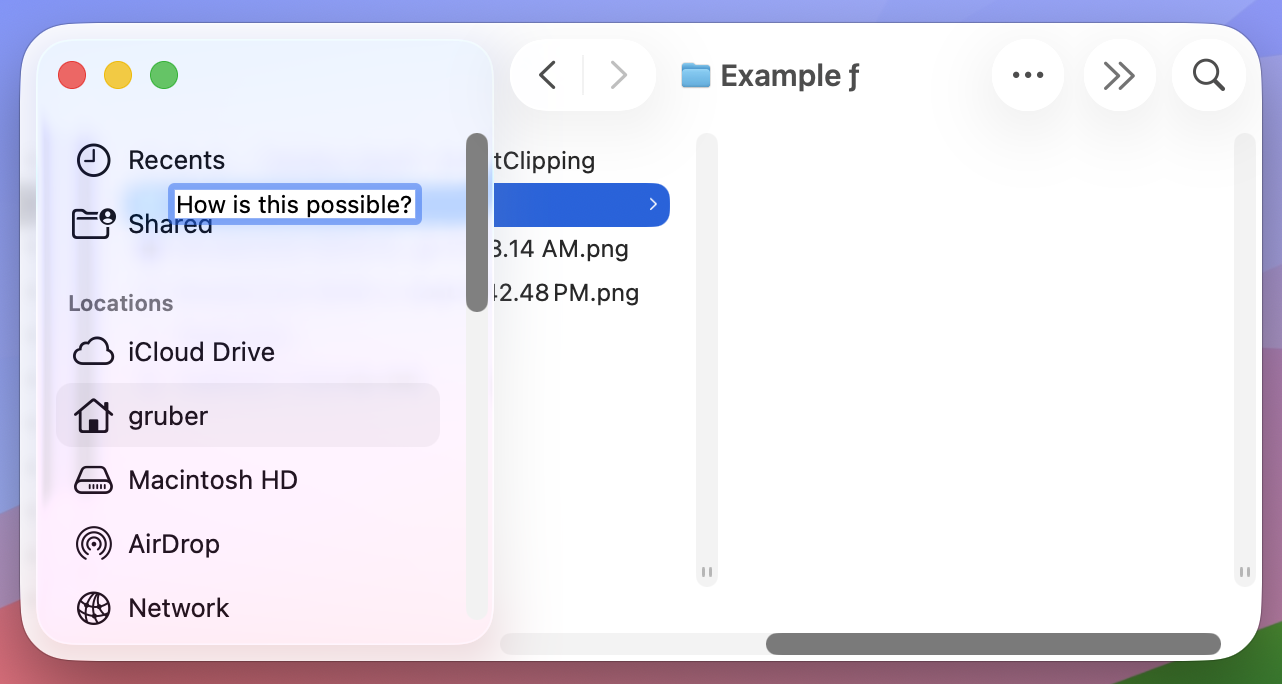
This new feature in the Tahoe Finder attempts to finally solve this problem. I played around with it this afternoon and it’s ... OK. It feels like an early prototype for what could be a polished feature. For example, it exacerbates some layering bugs in the Finder — if you attempt to rename a file or folder that is partially scrolled under the sidebar, the Tahoe Finder will just draw the rename editing field right on top of the sidebar, even though it belongs to the layer that is scrolled underneath. Here’s what it looks like when I rename a folder named “Example ƒ” to “How is this possible?”:
On MacOS 15, if you attempt to rename an item that is scrolled under the sidebar in column view, the column containing that item snaps into place next to the sidebar, so it’s fully visible. That snapping into place just feels right. The way Tahoe works, where the column doesn’t move and the text editing field for the filename just gets drawn on top of the sidebar, feels gross, like I’m using a computer that is not a Macintosh. Amateur hour.
I wish I could set this new column-resizing option only to grow columns to accommodate long filenames, and never to shrink columns when the visible items all have short filenames. But the way it currently works, it adjusts all columns to the width of the longest visible filename each column is displaying — narrowing some, and widening others. I want most columns to stay at the default width. With this new option enabled, it looks a bit higgledy-piggledy that every column is a different width.
Also, it’s an obvious shortcoming that the feature only adjusts columns to the size of the longest currently visible filename. If you scroll down in a column and get to a filename that is too long to fit, nothing happens. It just doesn’t fit.
Even a future polished version of this column view feature wouldn’t, in and of itself, be enough to tempt me to upgrade to Tahoe. After 30-some years of columns that don’t automatically adjust their widths, I can wait another year. But we don’t yet have a polished version of this feature. The unpolished version of the feature we have today only reiterates my belief that Tahoe is a mistake to be avoided. It’s a good idea though, and there aren’t even many of those in Tahoe.
The features noted above already make for a great upgrade. But as
I mentioned last year, one of the interesting problems
we’ve been pondering is how best to link to documents in native
apps. We’ve spent some time refining our solution to that problem,
Omni Links, which are now shipping first in OmniOutliner 6. With
Omni Links, we can link to content across all our devices, and we
can share those links with other people and other apps.
Omni Links support everything we said document links needed to
have. Omni Links work across all of Apple’s computing platforms
and can be shared with a team. They leverage existing solutions
for syncing and sharing documents, such as iCloud Drive or shared
Git repositories. They are easy to create, easy to use, and easy
to share.
Omni Links also power up Omni Automation, giving scripts and
plug-ins a way to reference and update content in linked documents — documents that can be shared across all your team’s devices.
There’s lots more in version 6, including a modernized UI, and many additions to Omni Automation, Omni’s scripting platform that works across both Mac and iOS — including really useful integration with Apple’s on-device Foundation Models, with, of course, comprehensive (and comprehensible) documentation.
It’s Omni Links, though, that strikes me as the most interesting new feature. The two fundamental models for apps are library-based (like Apple Notes) and document-based (like TextEdit). Document-based apps create and open files from the file system. Library-based apps create items in a database, and the location of the database in the file system is an implementation detail the user shouldn’t worry about.
OmniOutliner has always been document-based, and version 6 continues to be. There are advantages and disadvantages to both models, but one of the advantages to library-based apps is that they more easily allow the developer to create custom URL schemes to link to items in the app’s library. Omni Links is an ambitious solution to bring that to document-based apps. Omni Links let you copy URLs that link not just to an OmniOutliner document, but to any specific row within an OmniOutliner document. And you can paste those URLs into any app you want (like, say, Apple Notes or Things, or events in your calendar app). From the perspective of other apps, they’re just URLs that start with omnioutliner://. They’re not based on anything as simplistic as a file’s pathname. They’re a robust way to link to a unique document, or a specific row within that document. Create an Omni Link on your Mac, and that link will work on your iPhone or iPad too — or vice versa. This is a very complex problem to solve, but Omni Links delivers on the age-old promise of “It just works”, abstracting all the complexity.
I’ve been using OmniOutliner for at least two decades now, and Omni Links strikes me as one of the best features they’ve ever added. It’s a way to connect your outlines, and the content within your outlines, to any app that accepts links. The other big change is that OmniOutliner 6 is now a single universal purchase giving you access to the same features on Mac, iPhone, iPad, and Vision.
A macOS app that enhances control over Elgato lights, offering
features beyond the standard Elgato Control Center software.
Features:
Automatically turn lights on and off based on camera activity
Turn lights off when locking your Mac
Sync light temperature with macOS Night Shift
Lolgato also lets you set global hotkeys for toggling the lights and changing their brightness.
I’ve had a pair of Elgato Key Lights down at my podcast recording desk for years now. Elgato’s shitty software drove me nuts. Nothing seemed to work so I gave up on controlling my lights from software. I set the color temperature and brightness the way I wanted it (which you have to do via software) and then after that, I just turned them off and on using the physical switches on the lights.
I forget how I discovered Lolgato, but I installed back on November 10. I connected Lolgato to my lights, and set it to turn them on whenever the Mac wakes up, and off whenever the Mac goes to sleep. It has worked perfectly for over two months. Perfect little utility.
Hey folks, Fireside this week! Hopefully everyone enjoyed our series on the running debate over hoplites! As a social media note, I am going to attempt to start setting up a presence on Threads (with my own name, bretdevereaux, as my handle as always). I’m not leaving Bluesky by any means, just diversifying a bit; my presence on Twitter is likely to remain very limited as the quality of the discourse on that site has been…very poor. Which actually leads neatly into this week’s musing.
Percy (far) and Ollie (near) both suddenly confused as to why I am in my own hallway.
For this week’s musing, I wanted to just lay out some relatively scattered thoughts on where formal historical training and autodidacticism (being self-taught) meet. These thoughts were occasioned by some contretemps on the App Formerly Known As Twitter over the role of diversity and inclusion in the Roman Empire. The Banner of Formal Training was born forth capably and tirelessly in particular by Theo Nash (PhD student at the University of Michigan’s Interdepartmental Program in Mediterranean Art and Archaeology), while the autodidacts were a motley collection of enthusiast accounts without formal training (but many with a history of bigoted or white supremacist statements, because this is Musk-Era Twitter) huddled around the ‘Roman Helmet Guy.’1 The usual term for this crowd, collective are ‘statute profile pictures’ (or ‘statue Pfps’) though of course they do not all have marble statue profile pictures (but many do).
Now Classics is in an odd spot here because as a field that is under substantial pressure – we’ve talked about the history crisis but the classics crisis is much worse because where history departments shrink, Classics departments close – Classics is pretty damn eager for just about any supply of enthusiastic members of the public it can get. And yet it is difficult to recommend much dialogue with this crowd beyond debunking, in part because the Roman Helmet crowd is just aggressively hostile to actual training or expertise. They’ll insist they’re not hostile to knowledge – but only when that knowledge comes in the form of primary texts wholly uncontextualized by any other form of learning so that nothing gets in the way of them applying their preferred – often quite embarrassingly wrong – reading. Also, it is worth noting at the outset, many of them are quite appalling bigots, a facet which comes through in the ever more frequent unguarded moments and which contributes greatly to their inability to understand antiquity.
One of the motifs that this crowd appeals to frequently is the idea that academics and other professional historians and classicists are at least blinded by our training and ideology to the reality of antiquity, if not actively engaged in a conspiracy to conceal the past. Now on one level, this argument is fairly obviously self-serving and offered in bad faith, as a way to de-legitimize anyone who disagrees with their deeply ideologically inflected (oh irony!) view of antiquity. In the case of the current contretemps, they wanted to argue against the idea that Roman strength came from the unusual willingness and ability of the Romans to incorporate and include a wide range of peoples and cultures (an observation in such ample evidence that it has been commonplace among academics for many decades – to the point that even the hoary old racists of yestercentury had to admit it was true and were stuck arguing that it contributed to decline even though that chronology does not really work out). But the idea that academia is strongly ideologically inflected is culturally ubiquitous and worth addressing.
The thing is, it is simply true that there is a strong political ‘lean’ in most academic fields (although the insistence that this lean is universal is invariably wrong; there are conservative classicists and historians).2 And that lean does have a shaping impact on scholarship, particularly on the volume of scholarship directed towards some topics over others. But I think enthusiasts who imagine that this leaves entire ideologies wholly ‘frozen out’ have misunderstood how academic scholarship works in the humanities and the way that arguments get ‘pressure tested.’
And at least in history, it simply doesn’t. Journals and book publishers want to publish arguments that are going to spark a lot of debate and discussion, which means they want to publish provocative arguments, so long as those arguments are well made enough (in terms of evidence) to actually cause a serious discussion. In most journals, if you make an argument that makes the peer reviewers mad but they can’t disprove, the journal is going to ask you to revise to answer their specific complaints and then publish it because clearly that argument is on fire (in a good-for-the-journal way). A book publisher is going to be even more interested because controversy moves books. If everyone is writing articles about how you are a very great fool, well that’s a lot of people who need to get their libraries to buy copies of your book so they can make that argument.
Thus, Victor Davis Hanson does not struggle to get published even if he does tend to prefer publishers (The Free Press, Basic Books) which won’t edit him very much or push back much during peer review (but Warfare and Agriculture (1983) was University of California Press, Hoplites (1991) was a Routledge collection and the broadly pro-orthodoxy Men of Bronze (2013) in which he has a chapter was Princeton University Press; Western Way of War (1989) was picked up by Oxford University Press when it was a hit). Likewise, even a brief glance at the ‘Fall of Rome‘ debates will show that the often very conservative coded decline-and-fall scholars have no problem getting published. Bryan Ward-Perkins’ The Fall of Rome and the End of Civilization (2005) broadside, with a title (“The End of Civilization”) that pretty clearly puts it on a side in the broader cultural debates about the place of Rome for modern western societies, was published by Oxford University Press!
There is an ideological lean in academia and it can produce a kind of ‘chilling effect’ on certain forms of speech but it does not lock out ‘right-coded’ arguments from publication. I say this, of course, as someone whose book project on military materiel in the third and second century – ‘how stuff for fighting made the Romans the best at fighting and winning’ being a generally pretty ‘right-coded’ book topic! – is under contract with a very prestigious publisher! I got a book contract from the first press I approached. I can’t go into details, but I also have interest from another very prestigious press for writing about the Gracchi in which I was clear my take was a lot more negative (again, a ‘right-coded’ position) and the press seems – at this early stage where nothing is certain – very interested! No one is stopping me!3
What I find striking is that these (largely extreme right-wing) autodidacts are unwilling to put themselves into the arena and actually publish. Oh, they’ll write long posts on social media or on their substack, but submit to peer review? Never.
And it is simply not the case that peer reviewed scholarship is closed to autodidacts or those without degrees. The late, great Peter Connolly was not ‘Dr.’ Peter Connolly, he had a degree in art and started as an author-illustrator. But working alongside H. Russel Robinson for years, he achieved a very high degree of expertise on Roman military equipment and by the 1990s and 2000s, in addition to his for-the-public illustrated books, he was publishing original scholarship in peer-reviewed venues. Several of his articles (particularly his reconstruction of the sarisa) remain important in military equipment studies today and many of his books, although marketed to the public, are well regarded by scholars. No one kept him out!
Likewise and more recently, Janet Stephens was trained and worked as a hair-dresser, but got interested in the hair styles appearing on Roman sculpture that scholars had long concluded had to be wigs. She did her research, demonstrated that the hair-styles could be achieved through the use of natural hair and pins and published an article in the Journal of Roman Archaeology, one of the premier journals in the field. No one kept her out! Indeed, quite the contrary, she was widely lauded and made lots of appearances at academic conferences; I attended a talk she gave a number of years ago. My sense is that, in Roman sculpture studies, her conclusions have been largely accepted and the field has shifted its understanding as a result.
No one is stopping you trying to take your novel arguments about antiquity to a peer-reviewed journal and get them published. It doesn’t even cost anything to go through peer review in history or classics. Our journals do not charge!4 Apart from your time, it’s free.
But you have to be willing to leave your comfort zone, to leave your cozy little huddle of supporters who all think what you think and submit to criticism – potentially very harsh criticism. Peer review is double-blind and while it isn’t supposed to include personal attacks or vulgarity (and usually doesn’t), no punches are pulled: if the reviewer thinks your argument is flawed and idiotic they will say that, usually quite bluntly.
So I find it striking that these fellows are unwilling to step into the arena, as it were, to attempt to develop their arguments with real rigor beyond 280 characters or to defend them against real criticism. Instead it is the supposedly soft, duplicitous academics who engage in good faith, under our real names, with our work exposed to criticism and passing through the testing of peer review. Meanwhile the fellows who complain that we are ‘woke’ and ‘weak’ hide behind nom de plumes and write only in their sheltered walled gardens online, surrounded by an audience that knows as little about antiquity as they do and shares their viewpoints and so is equally both unprepared and unwilling to challenge them.
Cowards. I’m saying they’re all cowards. And if they disagree, they are welcome to ‘come at me bro’ in the pages of a peer-reviewed history or classics publication.
A scene from over the holidays, Ollie has decided that he is the present. Percy remains skeptical.
On to Recommendations!
First off, if you missed it, I had another piece at War on the Rocks, this time for their ‘Cogs of War’ series, a written interview on ‘What Thucydides Thought About Technology and War.‘ I am actually quite pleased that the editors let this one go, because on some level I was writing in answer to their questions that they had asked the wrong questions – that Thucydides is not, in fact, very focused on technology or production. But I think that is, in this case, the more interesting (and also accurate) observation: our focus on technology and production is itself historically contingent and not a universal view, which ought to give us pause and a bit of perspective.
We also have a new Pasts Imperfect, this time opening with an excellent essay by Inger N.I. Kuin on Diogenes and the remarkable range of ideas in ancient philosophy. It is an important point to make, especially at a time when it feels like every fellow who has half-read the Meditations is prepared to hold up that reading as the single, unified ‘wisdom of the ancients.’ In practice, the Greeks and the Romans thought many things and part of what made ancient philosophers interesting and controversial was that they often espoused viewpoints that went against prevailing cultural attitudes (there was a reason no one liked Socrates!).
Also, via that Pasts Imperfect, I wanted to highlight a recent episode of Anthony Kaldellis’ Byzantium and Friends podcast where he talked about the survival of small and endangered academic fields like Sumerology, Hittitology (that is, the study of the Sumerians and Hittites) and Byzantine studies with Sumerologist Jana Matuszak and Hittitologist Petra Goedegebuure. It’s striking to hear the discussion coming from fields even more endangered than Classics writ-large, but I think it is a really useful discussion, touching on how fragile small fields can be in an environment where higher education is shrinking where it isn’t collapsing. Critically, it is important to recognize that these fields are passing down key skills – like language skills in dead languages – which only a very small number of people have, that have to be continuously trained and preserved, or we’ll largely lose them (again). As a result, disruptions to these small fields can threaten to sever that thread of knowledge, leaving a poorer, less knowledgeable world.
Meanwhile in ancient military equipment news, archaeologists in Sunderland in England have found a deposit of some eight hundred Roman whetstones. The site has a large formation of sandstone, a good stone to use for whetstones and seems to have been a local production center, quarried on the north bank and then processed on the south bank. The 800 or so stones we have are likely production ‘rejects’ – not quite the right size, shape or consistency – and so were dumped. Discussions on the site have focused on the potential use of whetstones by the Roman army – Roman soldiers will have needed to sharpen their swords – but I think underplay the potential of whetstones as a ‘consumer good’ in an agrarian society where every farming household would need to keep plows, knives and sickles sharp too.
For this week’s book recommendation, I have a real gem of a recent book, O. Rees, The Far Edges of the Known World: Life Beyond the Borders of Ancient Civilization (2025).5 The book’s theme is there in the title: it takes as its focus not the usual centers of our perspectives on antiquity (mainland Greece and Roman Italy) but rather the ‘peripheries.’ But the delight of the book is in part that it centers these peripheries, treats them as the ‘main characters’ in their own stories, as they must have felt to the people who lived there at that time. These places exist on the edges of imperial power or cultural hegemony but that doesn’t mean they were ‘rough’ places – most of the places Rees takes us are urban, even cosmopolitan in nature, existing as they often did at the intersection of different cultures and empires. And of course these places at the ‘edge of the world’ (but the center of their own) are every bit as much a part of antiquity as the streets of Rome or the acropolis of Athens.
The book is structured into four sections each with a slightly different defined ‘core’ to which we shall find a periphery: the first section focused on the peripheries of Egypt (from pre-history through the bronze age), the second on the edges of the Greek world, the third on the edges of the Roman world and the fourth finally reaching far beyond the broader Mediterranean to the very edges of the world that our classical cultures even knew existed. Each section is then broken into three or four chapters, with each chapter picking a single place well beyond that ‘core.’ Rees takes us to a wide variety of places, some of which (Hadrian’s Wall, for instance) may feel familiar but many of which (Lake Turkana, Olbia, Naucratis, Volubilis, Aksum) will come as a delightful surprise to most readers.
What I like so much about this approach is that it treats each of these sites as the main characters of their own stories, through the evidence we have for them. That is often mediated through the great empires or hegemonic cultures (because that’s where our evidence is from) but it never becomes a story about the hegemons – it is a story about these places. And the reader quickly realizes that while to the Egyptians or Greeks or Romans these places must have seemed distant and ‘out of the way,’ they were at the centers of their own interconnected worlds. And Rees succeeds in writing carefully but evocatively about these places, with wonderful anecdotes grounded in archaeology or source testimony, like the long-distance trade contacts of Megiddo coming through from the banana proteins found in the remains of someone’s teeth or the striking moment where the Greek colony of Olbia – today in Ukraine – under siege saves itself by expanding citizenship to its resident foreigners and slaves to have the strength to resist attack.
The book is clearly written for a public audience, but is carefully footnoted for those who want more depth, so while it is a well-written and often pleasantly breezy read, it is also a serious work of scholarship. It also have a number of wonderful full-color plates that add some – you’ll have to pardon me – color to its descriptions. Alongside this, the book has some of the most consistently useful and helpful maps I’ve encountered in such a work, with each chapter featuring at least one (some several!) maps helping the reader situate where they are in relation to the rest of the ancient world. And I do want to stress, even I knew relatively little of many of these places prior to reading. So this is a book that is going to delight anyone interested in the ancient world but even if you know quite a lot about antiquity, you will find things here to expand your horizons.
As you know, dancing surged in New York City a few years ago when that Sodom and/or Gomorrah repealed a 1926 law making it illegal to operate any “public dance hall” or “cabaret” without a license. Not that those libertines waited until the repeal actually took effect. See “Stop That Dancing! Unlicensed Cabarets Are Still Illegal in New York” (Nov. 6, 2017). Well, predictably, now everybody in the state wants the same sort of freedom. This is what leniency breeds. See, e.g., ABC News, “Lawyers allege DHS is denying legal counsel to Minnesota detainees” (Jan. 18, 2026) (quoting attorney who claimed an ICE agent told him “if we let you see your clients, we would have to let all the attorneys see their clients, and imagine the chaos.”).
Still, New York’s governor, Kathy Hochul, who is up for reelection this year, openly pandered to the pro-dance lobby in her recent “State of the State” address. Among the pie-in-the-sky proposals Hochul outlined was the repeal of a similar state-wide restriction, saying she supported “dancing by default”:
Eliminating Outdated Restrictions on Dancing
For decades, complexity and lack of transparency in tavern, bar, and restaurant licensing has generated public confusion about dancing, often creating friction in communities. Under current rules, dancing is allowed in bars and taverns, after bureaucratic processes at the State Liquor Authority (SLA) and community board level[,] but is not always allowed in restaurants. Because of this, some applicants—especially those who want to operate as a restaurant at some times and a bar or tavern at other times—self-identify as restaurants but operate as nightclubs. This erodes community trust, leads to higher complaint volumes, and requires the SLA to enforce against dancing. [sic]
To improve trust and transparency and cut red tape, Governor Hochul will charge SLA with allowing dancing by default in taverns and bars and creating a new hybrid restaurant-tavern license. For bars and taverns, no processes or need for public hearings will change, and community boards will be able to maintain their role making further stipulations. There will be no change for restaurants, whose license types do not allow patron dancing. For applicants who want to operate as both a restaurant and bar or club at different times, the new hybrid license type will bring more transparency to the community, as the license will accurately reflect the character of the establishment. Qualifying license types will continue to require community disclosure and comment periods for dancing and performance dancing consistent with statutory obligations.
But having read that a few times now, it seems like nothing much would change. Bars and taverns would still have to get a dancing license, apparently subject to the veto of a “community board,” and restaurants would still be unable to get one at all. The only difference would be the new “hybrid license,” apparently meant to allow businesses that currently “operate as nightclubs” even though they “self-identify as restaurants” to end that embarrassing charade. I guess I support that, although I’m not sure labeling them as “hybrids” is the kind of acceptance they were hoping for.
Jo March has been hired to supervise Theodore Laurence’s studies. She allows no rewards. She allows no indulgences. Laurie, on the other hand, allows himself far too many thoughts—none of them related to Latin.
Wherein the Great Leader explains a mysterious, unexplainable event by explaining that it was due to an unknown and unexplained phenomenon. And everyone says, "Ah, of course, that explains it."
Before they can come out to the public, Patrick and Justin first, obviously, have to speak to the important people in their lives, starting with their families, and then the organizations and teams.
This is a difficult post. But then, these are difficult times.
This past Monday was the Rev. Dr. Martin Luther King, Jr. holiday, which seemed like propitious timing, considering the events of the past few weeks.
At church, our pastor gave a sermon about the principles of nonviolence as outlined by King, illustrated by hand-lettered posters, which were placed around the sanctuary. As the words went up and the congregation absorbed them, I felt myself stiffening a little. The pastor acknowledged this, saying that when several of her family members helped make the posters, one remarked, "Wow, you're really reaching here for perfection, aren't you?"
We stared at all of the posters, and I think particularly at the one that read, "My opponent is not evil."
Evil, I read this week, is the absence of empathy. ICE agents have made it clear this week that they are devoid of empathy. In fact, they seem to glory in their capacity for cruelty, to be eager to rub our noses in it. Look at what we can do to you all their actions seem to say, and you can do nothing to stop it.
They drag people from their homes and from their cars, including both immigrants who are following all the rules and have permission to be here, as well as citizens. They spray tear gas and other chemical irritants on crowds. They scream profanity and contempt at us. And so much more.
The difficulty of the principles of nonviolence is to commit to bear the consequences, no matter what. When you give yourself over to it, the resulting scenes of violence wreaked upon those not resisting shock the conscience of the world. Sometimes that is the only way that can change begin.
Like the protesters who allowed themselves to be beaten on the Edmund Pettus Bridge, the people of Minneapolis and St. Paul are standing up to whatever is thrown at them to say, "No more." And believe me, what is being thrown at us is really terrible.
This past weekend, I went to the Powderhorn Park Art Sled rally. I have lived in this neighborhood for over thirty years, but this was the first time I heard about this event. It was very well attended, as if everyone in the surrounding neighborhood decided, "The hell with it. Let's show the government that they can't destroy our community." Many of the slides had anti-ICE themes, and some were incredibly elaborate.
But the one I liked best of all was one of the simplest ones: A man throwing himself down on his belly and rocketing down the icy hill with a bright blue kite bobbing over his head that read "Be Good."
Image description: Light blue background. Text reads in posterboard lettering: 'My opponent is not evil' 'Friendship not Humiliation' 'Love is the Center' Nonviolence is Strength' 'Bear the Pain' 'God is on the side of Justice.' Center: a man lies outstretched on a sled. Above it bobs a blue kite with the words 'Be Good'
Once upon a time, the internet was all about hyperlinks. My first webpage, back in 1994-5, was roughly 40% links to other people’s pages about stuff I liked (if I recall correctly, an eclectic mixture of topics like chocolate, chillis and the lyrics of Bob Dylan), and other people linked to my musings on those topics. That webpage fell by the wayside quite early on, as my budding html skills were diverted towards developing a departmental webpage instead (and the start of a long process of annoyance and disillusionment, as universities implemented ever more restrictive content management systems and centralised control of webpages), but when I discovered blogging, rather late on, there was a similar feel; one blogged about other people’s blogs, engaged with their responses, linked to their ideas, and at least to some extent felt part of a community – or at any rate a network of alliances, semi-serious feuds and even friendships.
This doesn’t happen so much any more; the result of the shift of most activity onto platforms, so that the main way of attracting readers was to publicise oneself on Twitter and hope to get retweeted by someone with actual clout, and then the further shift onto paywalled newsletters by those with sufficient reputation and following to attract paying subscribers (still with the self-publicity, but much less likely to help publicise anyone else). But there are still some great blogs out there, and I am going to stick doggedly to my custom of posting an annual list of links to my favourite posts until the last of them either gives up or switches to Substack. There are places on the internet where it’s still 2003…
One blogger who has regularly appeared in those lists pretty well every year since 2019 – I’m actually surprised that she didn’t make it into every single one – is the feminist linguist Deborah Cameron, whose blog language: a feminist guide (https://debuk.wordpress.com) has an astonishing track record of insight and thought-provoking analysis, combining academic weight and dry humour. Compared with, say, my willingness to comment here on whatever briefly wanders into my butterfly mind, Deborah’s blog stuck to doing what it said on the tin, directing a powerful analytical spotlight towards different examples of gendered language usage – but there were and are so many examples of that, that it never felt remotely boring or repetitive. And, while it was rarely overtly polemical, it was clearly driven by the wish to make the world a better place, or at any rate to make the English language a bit less sexist.
This wasn’t the sort of blog where you would actually want a link to your own posts to appear, at least if you weren’t another feminist linguist, as it would almost certainly mean that you’d said something incredibly crass and were going to be elegantly dissected. But by chance I connected with Deborah by other means, an informal Sunday morning chat group on Facebook organised by a mutual friend – basically, this is the only reason I continue to have anything to do with Facebook – and it became clear that this was someone I would really hit it off with in real life. (And it remains a clear argument against knee-jerk social media bans for young people that the possibility of building real relationships with people you may never meet in person is genuine and can be a lifeline).
And the reason I’m writing this now is that we’ve had the last of Deborah’s posts, and I’ve had the last of those Sunday morning conversations, as she died earlier this week. This isn’t the first time I’ve experienced the strange feeling of mourning someone I’ve never met but felt I knew – not in the manner of David Bowie or Alan Rickman, where the ‘knowing’ is wholly one-sided and imaginary – but it doesn’t get any easier. A powerful, important and reassuring voice has fallen silent; all we can do is revisit her past posts, which I strongly recommend to all.
For weeks — maybe months, time has been hard to judge this past
year — Trump has been telling us that he’s worked out deals with
pharmaceutical companies to lower their prices by several hundred
percent. Commentators and comedians have pointed out that you
can’t reduce prices more than 100% and pretty much left it at
that, suggesting that Trump’s impossible numbers are due to
ignorance.
Don’t get me wrong. Trump’s ignorance is nearly limitless — but
only nearly. I’ve always thought that he knew the right way to
calculate a price drop; he did it the wrong way so he could quote
a bigger number. And that came out in yesterday’s speech.
Trump sophistry + math pedantry = Daring Fireball catnip.
The Texans have such a weird playoff history. They have existed since 2002. They first made the playoffs in 2011, winning the division. They would beat the Cincinnati Bengals and earn their first playoff win and first divisional round game. They would lose to the Baltimore Ravens. This season set a precedent: the Texans are division winners, and they lose in the divisional round.
Since that time, the Texans have reached the playoffs 8 more times. They have only gone 1-and-done twice. Every other year they have made it to the divisional round. The most peculiar part of this run of games was until 2025, this season, they had never been a wildcard team. They won the division and got a home game, or bust. So until this year it was safe to wonder if maybe the Texans only chance of going all the way was to earn the number 1 seed so they wouldn’t have to leave Houston and go lose somewhere else.
But this year they did it. They secured a wildcard berth for the first time in team history and went into Pittsburgh and won their first ever away playoff game. This team started 0-3 and was doing this. The defense was playing lights out. Maybe this year was different. NOPE!
The defense did their best against New England and produced a winnable performance…if the offense wasn’t putrid. CJ Stroud got picked 4 times in the first half and each one was more embarrassing than the last. To give out some excuses first: the weather was shit, the offensive line was injured, and Nico Collins was out. Those are reasonable reasons for struggle. The offense didn’t struggle. Stroud was embarrassing. So embarrassing that the goodwill from his rookie year has officially dried up completely. Stroud no longer has the grace of excuses. He’s approaching bust territory. He handled the Patriots’ pressure horribly. I found an interesting scouting report on reddit about Stroud pre-draft. Look at the negatives about how he handles pressure. Sure feels like all of that came true against New England, doesn’t it?
Stroud settled down a bit in the second half but it wasn’t enough. The Patriots could tee off on him without much risk. A competent or courageous QB wins this game for Houston. The talk went from him getting a massive extension to fans wondering if they should even pick up his 5th year option, considering how expensive that defense might get. The Ohio State QB curse remains intact for now.
He also fumbled 5 times in the two playoff games, as well as the 5 picks. Real bad stuff. His INT numbers might have been even worse if the weather was different, the Patriots looked like they were jumping every route but that ball was slippery.
The Texans are now stuck in a tough place because they aren’t likely to have a better option at QB next year. A competent QB and this Houston team was a contender. Instead, well…they get a truck crash comic.
![[personal profile]](https://www.dreamwidth.org/img/silk/identity/user.png) cimorene
cimorene![[syndicated profile]](https://www.dreamwidth.org/img/silk/identity/feed.png)